Magnets on Stainless Fridge: Why Some Don’t Stick & Backing Fixes

Magnets on stainless fridge doors often fail because austenitic stainless steel grades, 304 and 316, contain nickel and chromium alloys that are non-magnetic or only weakly magnetic. Ferritic grades like 430 attract magnets reliably, but most modern refrigerators use 304 or 316 for corrosion resistance. To fix this, specify neodymium disc backings for stronger pull, adhesive-backed steel plates for non-magnetic surfaces, or dual-system products combining both adhesive and magnetic attachment.
📋 Table of Contents
- Executive Summary
- Why Stainless Steel Grade Determines Magnet Hold
- Which Magnet Backing Fixes Weak or Non-Magnetic Surfaces?
- How to Test a Refrigerator Before Ordering Custom Magnets
- Matching Backing Strength to Product Weight and Material
- Production Risks: Backing Delamination, Adhesive Aging, and QA Testing
- Labeling and Packaging for International Retail
- Key Takeaways
Executive Summary
- Stainless steel is not one material: Austenitic grades 304 and 316 are non-magnetic or weakly magnetic due to nickel and chromium content, while ferritic grades like 430 attract magnets reliably.
- Neodymium discs improve pull on weakly magnetic surfaces: N35 or N42 grade neodymium magnets deliver stronger holding force than flexible ferrite, but cannot overcome a genuinely non-ferromagnetic surface.
- Adhesive-backed steel plates solve non-magnetic refrigerators: A thin ferromagnetic plate adhered to the refrigerator creates a magnetic surface for the souvenir magnet, suitable for 304/316 stainless, glass, and aluminum appliances.
- Dual-system products reduce retail returns: Packaging a magnet with an optional adhesive steel plate covers both magnetic and non-magnetic refrigerators, critical for international souvenir markets where appliance types vary.
- Production quality control prevents backing failure: Pull testing at pre-shipment inspection catches weak adhesive bonds, uneven resin backs, and undersized magnet discs before bulk shipment.
Why Stainless Steel Grade Determines Magnet Hold
Stainless steel magnetism depends on its crystal structure and alloy composition. Austenitic grades contain high levels of nickel and chromium, which stabilize a non-magnetic face-centered cubic structure. Ferritic and martensitic grades use less nickel and form a body-centered cubic or body-centered tetragonal structure that responds to magnetic fields.
Austenitic 304 and 316: Non-Magnetic or Weakly Magnetic
Grade 304 is the most common refrigerator stainless steel. It contains approximately 18% chromium and 8% nickel. This composition makes it corrosion-resistant and easy to clean, but it is non-magnetic in its annealed state. Cold working during door forming can introduce slight magnetism, so some 304 doors attract weak magnets while others do not.
Grade 316 adds molybdenum for superior corrosion resistance, often used in coastal or high-humidity climates. It is even less magnetic than 304. A standard ferrite disc magnet will not hold paper on a 316 refrigerator door.
Ferritic 430 and Martensitic 410: Magnetic Grades
Grade 430 contains 16-18% chromium and no nickel. Its ferritic structure is magnetic. Appliances using 430 stainless attract magnets reliably, but 430 is less corrosion-resistant than 304 and shows fingerprints more visibly, so it is less common in premium refrigerators.
Martensitic grades like 410 and 420 are magnetic and hardenable, used in cutlery and industrial applications. They rarely appear in refrigerator doors due to lower corrosion resistance and higher cost.
Composite and Coated Doors Add Another Layer
Some refrigerator doors use a thin stainless steel skin bonded to a non-ferromagnetic substrate, aluminum, plastic, or foam insulation. Even if the stainless layer is ferritic, the air gap or non-magnetic core weakens the magnetic circuit. Other doors apply a stainless-look coating over painted steel or glass, which may or may not be magnetic depending on the base material.
Buyers ordering custom souvenir magnets for international retail face all these variations. A magnet that holds perfectly on one refrigerator may slide or fall off another, even within the same product line.
Which Magnet Backing Fixes Weak or Non-Magnetic Surfaces?
The backing solution depends on whether the refrigerator surface is weakly magnetic or genuinely non-ferromagnetic. A stronger magnet improves hold on the former but cannot solve the latter.
Flexible Ferrite Sheet: Low-Cost, Light-Duty
Flexible ferrite is a rubber-bonded ceramic powder rolled into thin sheets. It is the cheapest backing option and works well for lightweight soft PVC magnets on magnetic surfaces. Typical pull strength is low, so it slides under heavy decorative faces or on weakly magnetic 304 stainless.
- Best for: Flat soft PVC magnets under 10 grams on painted steel refrigerators or magnetic whiteboards.
- Limitation: Weak pull on austenitic stainless; unsuitable for 3D resin or metal souvenirs.
Neodymium Disc (N35 or N42): Stronger Pull on Weakly Magnetic Surfaces
Neodymium-iron-boron magnets deliver pull strength many times higher than ferrite in the same volume. A 10 mm diameter N35 disc can hold a heavy 3D resin magnet on cold-worked 304 stainless that would reject a ferrite disc. N42 grade offers even stronger pull for the same size.
- Best for: Heavy 3D resin or die-cast metal magnets on weakly magnetic or composite refrigerator doors.
- Limitation: Cannot overcome a genuinely non-ferromagnetic surface like annealed 304, 316, glass, or aluminum. The magnet will not stick at all, regardless of grade or size.
Neodymium discs cost more than ferrite and require careful handling during production. They are brittle and can chip if dropped or pressed unevenly into resin or adhesive. Buyers should specify disc diameter, thickness, and grade at quotation to match product weight and expected surface type.
Adhesive-Backed Steel Plate for Non-Magnetic Surfaces
An adhesive-backed ferromagnetic plate solves the non-magnetic refrigerator problem. The buyer adheres the plate to the refrigerator door, creating a magnetic surface for the souvenir magnet. The plate is typically 0.3-0.5 mm cold-rolled steel with a pressure-sensitive adhesive on one side and a smooth finish on the other.
- Best for: Non-magnetic 304/316 stainless, glass, aluminum, or composite refrigerator doors.
- Limitation: Adhesive may fail on oily, textured, or dusty surfaces. The buyer must clean and dry the door before application, and some adhesives lose tack over time in humid or high-temperature environments.
Retail packaging should include clear instructions: clean the surface, peel the liner, press the plate firmly for 30 seconds, wait 24 hours before attaching the magnet. Buyers report that adhesive-backed products without these instructions generate returns and negative reviews.
Dual System: Magnet Plus Adhesive Plate
A dual-system product packages the decorative magnet with an optional adhesive steel plate. The buyer tests the refrigerator with the magnet first. If it holds, no plate is needed. If it does not, the buyer adheres the plate and attaches the magnet to it. This approach covers both magnetic and non-magnetic appliances in one SKU, reducing inventory complexity for international retailers.
- Best for: Souvenir shops, museum stores, and tourist attractions selling to buyers with unknown refrigerator types.
- Limitation: Higher unit cost due to the additional plate and packaging. Requires clear labeling so the buyer understands the two-step process.
We produce magnets in 3D resin, soft PVC, metal, and wood to your specification. Backing type, disc size, and adhesive selection are confirmed at quotation based on your product weight, decorative face material, and target market.
How to Test a Refrigerator Before Ordering Custom Magnets
The simplest diagnostic is to test the refrigerator with an ordinary magnet before finalizing a custom order. Use a small neodymium disc or a standard ferrite fridge magnet and press it against the door. If it holds paper firmly, the surface is magnetic. If it slides or falls, the surface is weakly magnetic or non-ferromagnetic.
Testing Procedure for Buyers
Buyers placing large orders should test multiple refrigerator models in their target market. Appliance showrooms, retail stores, and customer homes provide real-world data. Test both the door center and the edges, as some doors use magnetic steel in the frame but non-magnetic stainless on the face panel.
- Step one: Press a neodymium disc magnet against the refrigerator door center and release. If it holds without sliding, the surface is magnetic.
- Step two: Attach a sample souvenir magnet of the same weight and size as the planned product. Leave it for 24 hours and check for sliding or falling.
- Step three: Repeat the test on stainless steel, painted steel, and any composite or glass-front models in the buyer’s market.
Retailers selling internationally should assume a mix of magnetic and non-magnetic refrigerators. A dual-system product or clear labeling that the magnet requires a magnetic surface reduces returns.
What to Tell the Supplier at Quotation
Share test results with the supplier during quotation. Specify the refrigerator models tested, whether the magnet held, and any sliding observed. This allows the supplier to recommend backing type, disc size, and adhesive grade. For example, a heavy 3D resin magnet tested on weakly magnetic 304 stainless may need a 12 mm N42 neodymium disc instead of a standard 10 mm N35 disc.
If testing reveals a significant portion of non-magnetic refrigerators in the target market, request a dual-system quotation or specify adhesive-backed steel plates as a separate SKU.
Matching Backing Strength to Product Weight and Material
Backing strength must exceed the combined weight of the decorative face, adhesive, and any coating or finish. A small single disc may hold a light soft PVC magnet but slide under a heavy 3D resin piece.
Soft PVC Magnets: Flexible Ferrite or Small Neodymium
Soft PVC is injection-molded rubber, typically 2-5 mm thick. A flat design without heavy metal inserts weighs less than 10 grams. Flexible ferrite sheet provides adequate hold on magnetic surfaces. For weakly magnetic refrigerators or international retail, specify a small neodymium disc instead.
3D Resin Magnets: Neodymium Disc Sized to Weight
3D resin magnets are cast in layers, building relief and color separation. A detailed design with multiple color pours can weigh 15-30 grams or more. The resin back is often uneven due to shrinkage during curing, so the magnet disc must be large enough to bridge small gaps and maintain contact with the refrigerator surface.
A 10 mm diameter N35 neodymium disc holds approximately 1.2 kg of pull force on a flat ferromagnetic surface in direct contact. In practice, an uneven resin back, a weakly magnetic refrigerator, or a thick clear-coat finish reduces effective pull. Buyers should specify disc diameter and thickness at quotation and request a pull test during pre-shipment inspection.
Metal and Wood Magnets: Weight and Surface Finish
Die-cast zinc alloy magnets with enamel paint and plating are heavier than resin. A 50 mm design can weigh 25-40 grams. Wood magnets are lighter but may have an uneven laser-cut back that creates air gaps. Both require neodymium discs sized to weight and back flatness.
Buyers ordering metal or wood magnets should ask for a physical sample to verify backing hold before bulk production. A sample that slides on a test refrigerator indicates undersized backing or poor adhesive bond.
Production Risks: Backing Delamination, Adhesive Aging, and QA Testing
Backing failure in the field generates returns and damages brand reputation. Common production risks include weak adhesive bonds, uneven resin backs, undersized magnet discs, and adhesive aging during storage or transit.
Backing Delamination in 3D Resin Magnets
Resin shrinks as it cures, creating stress at the adhesive bond between the resin back and the magnet disc. If the adhesive is applied unevenly or the resin surface is not cleaned before bonding, the disc can peel off during handling or in the field. Buyers report receiving magnets where the disc falls out of the packaging before the product reaches the shelf.
In practice: Resin magnets are cast in layers, so the back surface is never perfectly flat. A strong adhesive bond requires cleaning the cured resin back with isopropyl alcohol and applying adhesive evenly across the full disc diameter before pressing the magnet into place.
Adhesive Aging on Steel Plates
Pressure-sensitive adhesives on steel plates lose tack over time, especially in high-temperature or high-humidity storage. A plate that adheres firmly when fresh may fail after six months in a warehouse or shipping container. Buyers should specify adhesive grade and ask for aging test data at quotation.
Acrylic foam adhesives perform better than rubber-based adhesives in humid climates. Silicone adhesives resist high temperatures but may not bond well to oily or dusty refrigerator surfaces. The supplier should recommend adhesive type based on the buyer’s storage conditions and target market climate.
Pull Testing at Pre-Shipment Inspection
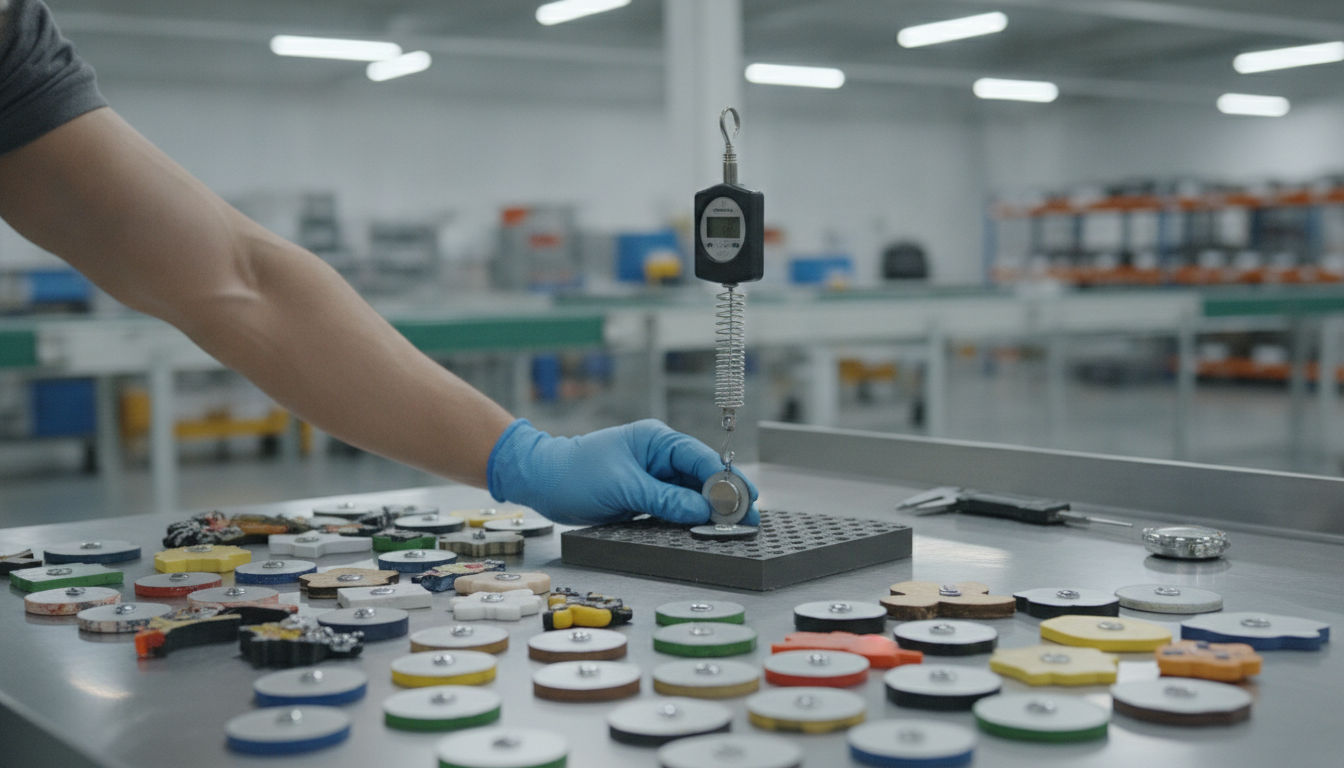
Every order goes through a design proof and a physical sample sign-off before bulk production. Pre-shipment inspection should include pull testing: attach the magnet to a ferromagnetic test plate, apply perpendicular force with a spring scale, and record the force required to detach the magnet. This catches weak adhesive bonds, undersized discs, and uneven backs before shipment.
Buyers should specify minimum pull force at quotation. For example, a 20-gram 3D resin magnet might require a minimum pull force of 200 grams to ensure it holds paper and light items without sliding. The supplier records pull test results and includes them in the pre-shipment inspection report.
Labeling and Packaging for International Retail
Clear labeling reduces returns and customer complaints. Buyers selling magnets on stainless fridge surfaces in multiple countries should include surface-compatibility information on the packaging.
Surface Compatibility Label
A simple icon or text label tells the buyer whether the magnet works on magnetic surfaces only, non-magnetic surfaces with the included plate, or both. For example:
- Magnetic surfaces only: ‘For use on magnetic refrigerators, whiteboards, and metal cabinets. Not suitable for stainless steel grade 304 or 316.’
- Dual system: ‘Includes adhesive steel plate for non-magnetic surfaces. Test magnet first; if it does not hold, apply plate to surface and attach magnet to plate.’
- Adhesive plate only: ‘Adhesive-backed. Clean and dry surface before application. Wait 24 hours before attaching magnet.’
Labeling in the buyer’s language improves compliance. Retailers in Germany, France, and Japan should request labels in German, French, and Japanese at quotation.
Packaging Instructions for Dual-System Products
Dual-system products require clear instructions so the buyer understands the two-step process. A small printed card inside the packaging works better than text on the outer sleeve, which may be discarded. The card should show:
- Step one: Test the magnet on your refrigerator. If it holds, you are done.
- Step two: If the magnet does not hold, clean the refrigerator surface, peel the liner from the adhesive plate, press firmly for 30 seconds, wait 24 hours, then attach the magnet to the plate.
Icons or photos reduce language barriers. Buyers selling in tourist areas with international visitors should use visual instructions only.
Barcode and SKU Management
Retailers using point-of-sale systems need unique barcodes for each SKU. A dual-system product is a single SKU with one barcode, even though it contains two components. Buyers should confirm barcode placement and format at quotation, especially for museum stores and gift shops using inventory management software.
Some buyers request separate SKUs for magnet-only and dual-system versions of the same design to track return rates and surface-compatibility issues. This requires separate production runs and packaging, increasing unit cost but providing better data for future orders.
Key Takeaways
- Austenitic stainless steel grades 304 and 316 are non-magnetic or weakly magnetic due to nickel and chromium content, while ferritic grade 430 attracts magnets reliably.
- Neodymium disc magnets in N35 or N42 grade deliver stronger pull than flexible ferrite on weakly magnetic surfaces, but cannot overcome genuinely non-ferromagnetic refrigerators.
- Adhesive-backed steel plates create a magnetic surface on non-magnetic 304/316 stainless, glass, and aluminum appliances, solving the compatibility problem for international retail.
- Dual-system products that include both a magnet and an optional adhesive plate reduce returns by covering magnetic and non-magnetic refrigerators in one SKU.
- Pull testing during pre-shipment inspection catches weak adhesive bonds, undersized magnet discs, and uneven resin backs before bulk shipment.
- Clear labeling and packaging instructions in the buyer’s language reduce customer confusion and improve compliance with surface-preparation steps for adhesive plates.
Can a stronger magnet make any refrigerator magnetic?
No. A stronger neodymium magnet improves hold on weakly magnetic surfaces like cold-worked 304 stainless, but it cannot create magnetism where none exists. Annealed 304, grade 316, glass, aluminum, and composite refrigerator doors are non-ferromagnetic. The only solution is an adhesive-backed steel plate that creates a magnetic surface, or a dual-system product that includes both magnet and plate.
How do I know if my refrigerator is magnetic before ordering custom magnets?
Test the refrigerator door with a small neodymium disc or standard fridge magnet. Press it against the door center and release. If it holds paper without sliding, the surface is magnetic. If it slides or falls, the surface is weakly magnetic or non-ferromagnetic. Test multiple locations on the door, as some models use magnetic steel in the frame but non-magnetic stainless on the face panel. Share test results with your supplier at quotation so they can recommend the correct backing type and disc size.
What adhesive works best for steel plates on stainless refrigerators?
Acrylic foam adhesives perform well in humid climates and resist aging better than rubber-based adhesives. Silicone adhesives handle high temperatures but may not bond to oily or dusty surfaces. The buyer must clean and dry the refrigerator door before applying the plate, and wait 24 hours for full bond strength. Ask your supplier for adhesive grade and aging test data at quotation, especially for products stored in warehouses or shipped in containers through hot or humid regions.
Ordering custom souvenir magnets for stainless or non-magnetic refrigerators?
Request a Quote with Backing Specs →
Written by the Magnista export team, who coordinate design proofs, sampling and production for custom souvenir magnets.