Travel Magnets Display Board: Size Guide & Capacity Chart

Collectors and gift shops display travel magnets on wall-mounted metal or magnetic boards sized from 12 × 18 inches for small collections to 24 × 36 inches or larger for extensive galleries, with capacity determined by magnet size and spacing. A 16 × 20 inch board typically holds 20-30 standard 2-3 inch magnets with comfortable spacing, while a 24 × 36 inch board accommodates 80-120 pieces. Board dimensions should match the magnet assortment you stock: 3D resin and soft PVC souvenir magnets range from 2 to 4 inches, metal designs from 1.5 to 3 inches, and wood laser-cut pieces from 2.5 to 5 inches.
📋 Table of Contents
- Executive Summary
- What are the standard souvenir magnet sizes retailers stock?
- How do board dimensions determine magnet capacity?
- Does magnet material affect board selection?
- How should gift shops arrange travel magnets on display boards?
- What magnet specs should buyers specify for display compatibility?
- Key Takeaways
Executive Summary
- Board capacity: A 16 × 20 inch travel magnets display board holds 20-30 standard 2-3 inch magnets with spacing, while 24 × 36 inch boards accommodate 80-120 pieces for museum stores and tourist attractions.
- Magnet size ranges: 3D resin and soft PVC souvenir magnets typically measure 2-4 inches, metal designs 1.5-3 inches, and laser-cut wood pieces 2.5-5 inches across the longest dimension.
- Material weight considerations: Metal boards rated for 3-5 pounds per square foot handle heavy 3D resin magnets, while lightweight soft PVC and thin metal designs work on any magnetic surface.
- Retail display strategy: Gift shops organize magnets by destination or theme in vertical columns, leaving 0.5-1 inch spacing between pieces to prevent visual clutter and allow customers to see individual designs.
- Custom production alignment: Buyers should specify magnet dimensions and backing thickness during quotation to ensure the finished product fits standard retail display boards and collector wall panels.
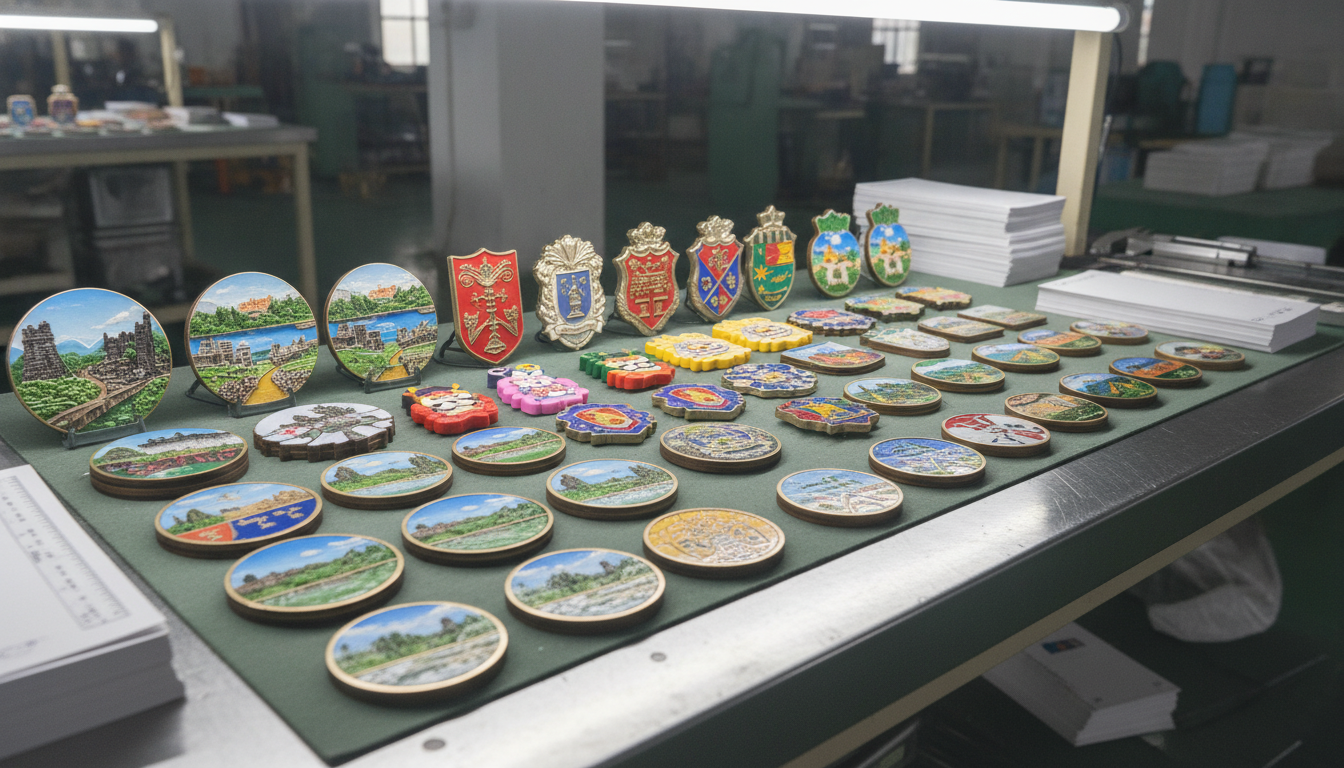
What are the standard souvenir magnet sizes retailers stock?
Souvenir shops and museum stores stock travel magnets in three common size categories. Understanding these dimensions helps you choose the right display board capacity and plan shelf footprint before ordering custom inventory.
Small magnets: 1.5-2.5 inches
Metal stamped-brass and die-cast zinc alloy magnets with enamel paint typically fall in this range. These compact designs work well for destination logo marks, simple icons, and minimalist city skyline silhouettes. Small magnets allow higher density on a display board but require tighter spacing discipline to avoid a cluttered appearance. A 16 × 20 inch board can hold 40-50 small magnets if arranged in a grid, though most retailers leave breathing room and display 25-35 pieces for better visual impact.
Medium magnets: 2-4 inches
This is the most common size for 3D resin and soft PVC souvenir magnets. Multi-layer resin relief designs and injection-molded soft rubber magnets in this range offer enough surface area for detailed artwork, recognizable landmarks, and vivid color separation. Medium magnets balance shelf presence with inventory variety. A 20 × 30 inch travel magnets display board comfortably holds 40-65 medium pieces with 0.5-1 inch spacing, allowing customers to browse individual designs without overlap.
Large magnets: 4-6 inches
Laser-cut wood magnets and premium 3D resin collector pieces often reach 4-6 inches. These statement magnets anchor a display and attract attention from across the store. Large magnets require more board real estate: a 24 × 36 inch panel holds 20-30 large pieces with proper spacing. Tourist attractions and flagship museum stores use oversized boards (30 × 40 inches or larger) to showcase extensive collections of large-format magnets without crowding.
How do board dimensions determine magnet capacity?
Board capacity depends on magnet size, spacing strategy, and whether you arrange pieces in a grid or organic layout. The table at the top of this guide provides baseline estimates for 2-3 inch magnets with comfortable spacing.
Calculating usable surface area
A 16 × 20 inch board offers 320 square inches of total surface. Subtracting a 1-inch border around the perimeter (to prevent magnets from sitting at the very edge) leaves roughly 14 × 18 inches, or 252 usable square inches. A 2.5-inch magnet occupies approximately 6.25 square inches. With 0.5-inch spacing on all sides, each magnet claims a 3 × 3 inch footprint (9 square inches). Dividing 252 by 9 gives a theoretical maximum of 28 magnets. In practice, irregular magnet shapes and visual balance reduce this to 20-25 pieces.
Grid versus organic arrangement
Grid layouts maximize capacity and create a clean, orderly appearance. Museum stores and airport gift shops often use grids to display large assortments by destination. Organic arrangements, where magnets are placed without strict alignment, feel more personal and work well for boutique shops and collector home displays. Organic layouts typically reduce capacity by 15-20 percent compared to grids because irregular spacing leaves more empty board area.
Heavy 3D magnets and board thickness
3D resin magnets with thick relief layers can weigh 20-40 grams each. A 24 × 36 inch board holding 100 heavy magnets carries 2-4 kilograms (4.4-8.8 pounds) of total weight. Metal display boards should be 0.5-0.8 millimeters thick to prevent bowing under load. Thinner boards sag in the center when loaded with heavy magnets, creating an unprofessional appearance and making it harder for customers to remove pieces. Buyers sourcing large 3D resin magnets should request board thickness specifications from display suppliers before committing to a size.
Does magnet material affect board selection?
Yes. Magnet material and construction determine weight per piece, which influences board load capacity and mounting requirements.
- 3D resin magnets: Multi-layer resin relief with separate color pours creates thick, heavy magnets. A 3-inch 3D resin piece typically weighs 25-35 grams. These magnets require sturdy metal boards and secure wall anchors to prevent the board from pulling away from the wall over time.
- Soft PVC magnets: Injection-molded soft rubber magnets are lightweight, usually 10-15 grams for a 3-inch piece. Soft PVC works on any magnetic surface, including thin metal sheets and flexible magnetic panels. Gift shops using portable or countertop displays prefer soft PVC because the lighter weight allows smaller board sizes and easier repositioning.
- Metal magnets: Die-cast zinc alloy and stamped brass magnets with enamel paint fall in the middle, around 15-25 grams for a 2-3 inch design. Metal magnets have strong magnetic backing and adhere firmly to boards, reducing the risk of pieces sliding or falling during customer browsing.
- Wood magnets: Laser-cut wood with UV printing is lightweight (8-12 grams for a 3-inch piece) but often larger in dimension (4-6 inches). Wood magnets require more board surface area per piece but do not stress the board structure. A 20 × 30 inch panel easily supports 40-50 wood magnets without bowing.
In practice: 3D resin magnets are cast in layers, so a physical sample is the only way to confirm that fine relief detail and small color areas survive the pour and that the finished magnet sits flat on a display board before bulk production starts.
How should gift shops arrange travel magnets on display boards?
Effective merchandising balances visual appeal with browsing ease. Customers should be able to see individual designs, read any text, and remove magnets without disturbing neighboring pieces.
Organize by destination or theme
Most souvenir shops group magnets by city, region, or country. A museum store might dedicate one section of the board to local landmarks, another to national parks, and a third to international destinations. This organization helps customers find magnets that match their travel history and encourages repeat purchases as they add new destinations. Tourist attractions often display only location-specific magnets, arranged by attraction feature (main building, gardens, special exhibits) to reinforce the visitor experience.
Vertical columns versus horizontal rows
Vertical columns guide the customer’s eye downward and make it easy to scan a large assortment. Horizontal rows work better for smaller boards and create a gallery-wall aesthetic. Gift shops with limited wall space often use vertical columns to maximize the number of visible designs within a narrow board footprint. A 12 × 36 inch vertical board can display 30-40 small to medium magnets in three or four columns, fitting into tight spaces between shelves or near checkout counters.
Spacing and visual breathing room
Leave 0.5-1 inch between magnets to prevent visual clutter and make it easier for customers to remove pieces without knocking others loose. Tightly packed magnets create a busy, overwhelming display that discourages browsing. Generous spacing highlights individual designs and makes the board feel curated rather than crowded. Retailers selling premium or large-format magnets should increase spacing to 1-2 inches to emphasize the quality and detail of each piece.
Mixing magnet types on one board
Combining 3D resin, soft PVC, metal, and wood magnets on a single travel magnets display board adds texture and variety. Group magnets by material in distinct zones to help customers compare construction and finish. For example, place all metal magnets in the top third, 3D resin in the middle, and wood at the bottom. This zoning prevents the board from looking chaotic while showcasing the full range of materials and price points in your assortment.
What magnet specs should buyers specify for display compatibility?
When ordering custom souvenir magnets, specify dimensions, backing type, and weight to ensure the finished product fits your display boards and meets customer expectations.
Magnet dimensions and shape
Standard rectangular and square magnets (2 × 3 inches, 3 × 3 inches) stack neatly in grids and maximize board capacity. Irregular shapes (state outlines, landmark silhouettes, animal forms) create visual interest but reduce capacity because they leave more empty space between pieces. Buyers should request a design proof showing the magnet’s exact dimensions and outline before approving production. This proof confirms that the shape will fit your intended board layout and that no critical design elements extend into areas that will be hidden by neighboring magnets.
Magnetic backing strength
Souvenir magnets use flexible magnetic sheeting or hard ferrite disc magnets on the back. Flexible sheeting works for lightweight soft PVC and thin metal magnets but may not hold heavy 3D resin pieces securely on vertical boards. Hard ferrite discs provide stronger pull and prevent magnets from sliding down the board over time. Buyers sourcing large or heavy magnets should specify ferrite disc backing and request a sample to test pull strength on their actual display boards before committing to bulk production.
Thickness and flatness
Magnets thicker than 5-6 millimeters can interfere with neighboring pieces on densely packed boards. 3D resin magnets with high relief should be tested for flatness: if the magnet rocks or tilts when placed on a flat surface, it will not sit flush against the display board and may fall off. Buyers should sign off on a physical sample that demonstrates the magnet sits flat and adheres firmly to a vertical metal surface. This sample check catches production issues (warped resin, uneven backing placement) before bulk manufacturing begins.
Packaging for retail display
Magnets sold individually need backing cards or clear poly bags with printed headers. Backing cards should include a barcode, product name, and destination or theme label. The card size affects shelf and board presentation: oversized cards (larger than the magnet itself) take up more display space but provide room for marketing copy and imagery. Compact cards (matching the magnet footprint) maximize board capacity and create a cleaner look. Buyers should specify card dimensions and printing requirements at quotation to ensure the packaged magnet fits your merchandising plan.
Before bulk production: design proof, physical sample sign-off, and pre-shipment inspection confirm that magnet dimensions, backing strength, and flatness meet your display board requirements.
Key Takeaways
- A 16 × 20 inch travel magnets display board holds 20-30 standard 2-3 inch souvenir magnets with comfortable spacing, while a 24 × 36 inch board accommodates 80-120 pieces for larger collections and retail merchandising.
- 3D resin magnets with multi-layer relief are heavier and require thicker metal boards (0.5-0.8 millimeters) to prevent bowing, while lightweight soft PVC and wood magnets work on any magnetic surface including thin panels.
- Gift shops should organize travel magnets by destination or theme in vertical columns, leaving 0.5-1 inch spacing between pieces to prevent visual clutter and allow customers to browse individual designs without disturbing neighboring magnets.
- Buyers ordering custom souvenir magnets should specify dimensions, backing type (flexible sheeting or hard ferrite disc), and thickness at quotation to ensure the finished product fits standard display boards and sits flat on vertical surfaces.
- Magnet size ranges differ by material: 3D resin and soft PVC pieces typically measure 2-4 inches, metal designs 1.5-3 inches, and laser-cut wood magnets 2.5-5 inches, with larger formats requiring more board real estate and lower display density.
- Retailers mixing multiple magnet materials on one board should group by type in distinct zones (metal in the top third, 3D resin in the middle, wood at the bottom) to help customers compare construction and finish without creating a chaotic appearance.
Can you use a refrigerator door instead of a wall-mounted board for retail display?
Refrigerator doors work for small personal collections but are impractical for retail merchandising. Commercial refrigerators in break rooms or storage areas are not customer-facing, and using a home-style refrigerator in a retail space looks unprofessional and limits display capacity. Wall-mounted metal boards offer better visibility, higher capacity, and a cleaner presentation. Gift shops and museum stores should use dedicated magnetic display boards sized to their inventory and wall space rather than repurposing appliances.
How do you prevent magnets from sliding down a vertical display board?
Sliding happens when the magnetic backing is too weak for the magnet’s weight or when the board surface is painted or coated, reducing magnetic pull. Use hard ferrite disc magnets instead of flexible magnetic sheeting for heavy 3D resin pieces, and ensure the display board is bare galvanized steel or powder-coated with a thin finish that does not interfere with magnetic adhesion. Test a physical sample on your actual board before ordering in bulk to confirm the magnet holds securely on a vertical surface without sliding or falling.
What is the best board material for heavy 3D resin magnet collections?
Galvanized steel or powder-coated steel boards 0.5-0.8 millimeters thick provide the strength and magnetic pull needed for heavy 3D resin magnets. Thinner boards bow under the weight of large collections, and non-metal surfaces (wood, cork, fabric) do not support magnetic adhesion. Buyers should request board thickness and material specifications from display suppliers and confirm the board is rated to hold the total weight of their magnet assortment before installation.
Planning a custom souvenir magnet assortment for your gift shop or museum store?
Request a quote by material and size →
Written by the Magnista export team, who coordinate design proofs, sampling and production for custom souvenir magnets.