How US State Souvenir Magnets Are Designed & Produced for Retail
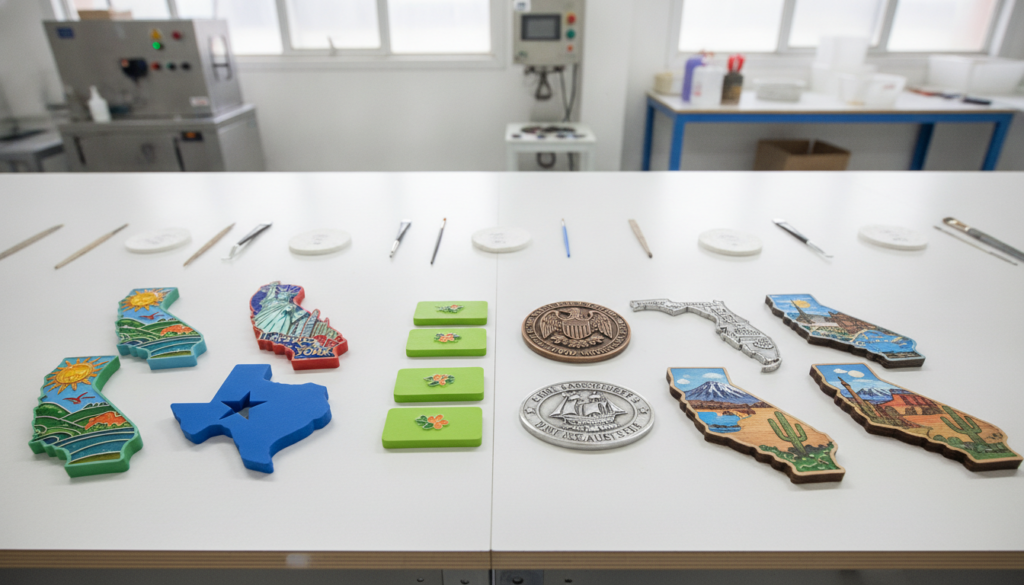
US souvenir state magnets are designed by combining state outlines or map silhouettes with full-color destination artwork, then produced through 3D resin casting, soft PVC injection molding, die-cast metal with enamel paint, or laser-cut wood with UV printing. Buyers submit artwork, approve a digital proof, sign off on a physical sample, and receive pre-shipment inspection before bulk production ships.
📋 Table of Contents
Executive Summary
- Four core processes: 3D resin for multi-layer relief and vivid color separation, soft PVC for clean color blocks and flexible edges, die-cast metal for enamel detail and perceived value, laser-cut wood for natural texture and engraved line art.
- Design proof and sample sign-off: Every order goes through digital proof approval and physical sample inspection before bulk production starts, reducing color mismatch and artwork placement errors.
- Retail packaging essentials: Polybag with backing card, barcode label, display hook, and clear product window are standard; custom retail boxes and blister packs are confirmed at quotation.
- Magnet strength verification: Buyers report weak or poorly positioned backing magnets that rotate or fall when refrigerator doors move; pre-shipment checks confirm pull strength on vertical surfaces before shipping.
- Landed cost planning: FOB pricing, freight, customs duty, and inland delivery must be calculated together; minimums, tooling, and lead time are confirmed at quotation for each process and design.

Which Process Suits Each State Design Style?
Process selection determines color accuracy, detail resolution, durability, and retail price point. Each of the four processes handles state outlines, landmarks, and typography differently, so matching the design style to the production method prevents blurry text, color bleed, and weak perceived value at retail.
3D Resin for Multi-Layer Relief and Vivid Color
3D resin magnets are cast in layers, allowing raised state outlines, landmark silhouettes, and text to sit above a colored base. The process delivers vivid color separation and a glossy finish that catches light on retail displays. Thin text and small color areas must be verified on the physical sample, because detail smaller than the resin pour thickness can blur or merge during casting.
Resin works well for designs combining a state map with iconic landmarks such as the Golden Gate Bridge for California, the Statue of Liberty for New York, or Mount Rushmore for South Dakota. The raised relief creates a premium tactile feel that justifies higher retail pricing compared to flat-printed alternatives.
Soft PVC for Clean Color Blocks and Flexible Edges
Soft PVC magnets are injection-molded, producing clean edges and solid color blocks without paint or printing. The material is flexible, so state shapes with thin peninsulas or narrow sections resist breakage during shipping and handling. Color matching is controlled by the raw PVC compound, not a surface coating, so the finish stays consistent across large production runs.
PVC suits bold, graphic designs with limited color counts: state outlines filled with one or two colors, large sans-serif typography, and simple icon placement. Fine gradients, photographic images, and small serif fonts do not reproduce well in molded PVC and should be assigned to resin or metal processes instead.
Die-Cast Metal with Enamel Paint for Detail and Perceived Value
Die-cast zinc alloy magnets are stamped or cast, then filled with enamel paint and finished with nickel, gold, or antique plating. The process delivers sharp edge definition and fine detail reproduction, making it suitable for state seals, intricate landmark outlines, and multi-color crests. Metal magnets feel heavier and more substantial than resin or PVC, which supports premium retail positioning.
Enamel paint sits in recessed areas of the metal base, so the design must include raised metal borders or separators between color zones. Designs without these separators require screen printing or offset printing on a flat metal surface, which changes the finish and durability profile.
Laser-Cut Wood for Natural Texture and Engraved Line Art
Wooden magnets are laser-cut from plywood or MDF, then engraved and finished with UV printing for full-color artwork. The natural wood grain adds texture and warmth, differentiating the product from plastic and metal alternatives. Laser engraving produces high-contrast line art, so state outlines, text, and simple icons work well; photographic images require UV printing, which sits on the wood surface and can wear with repeated handling.
Wood magnets appeal to buyers targeting eco-conscious tourists and gift shops emphasizing natural materials. The backing magnet must be sized and positioned correctly, because buyers report that small central magnets cannot hold larger wooden shapes securely, causing the magnet to rotate or fall when the refrigerator door moves.
What Artwork Format and Resolution Do You Need?
Artwork quality determines whether fine text, small logos, and color gradients survive production. Suppliers require vector files for clean edge reproduction and high-resolution raster files for photographic elements; submitting low-resolution JPEGs or screenshots leads to blurry images and rejected samples.
Vector Files for Outlines, Text, and Logo Elements
State outlines, landmark silhouettes, and typography should be supplied as vector files in AI, EPS, or PDF format with all fonts converted to outlines. Vector artwork scales without quality loss, so the same file works for magnets ranging from small lapel-pin sizes to large display pieces. Text smaller than 1.5 millimeters in the final magnet size may blur or close up during resin casting or enamel filling, so the design proof stage is the point to enlarge or simplify small type.
Buyers sometimes misunderstand artwork templates and expect text or rim elements to appear differently than they do in production. The design proof shows exactly how state borders, landmark icons, and text will be positioned, and any adjustment must be requested before the physical sample is cast or molded.
High-Resolution Raster Files for Photographic Backgrounds
Full-color photographic images of state parks, city skylines, or tourist attractions require raster files at 300 DPI or higher, saved as TIFF, PNG, or high-quality JPEG. Images pulled from websites or social media are typically 72 DPI and will appear pixelated when printed or UV-coated onto the magnet surface.
Color mode must be CMYK for printing processes and RGB for UV printing on wood; suppliers convert files if necessary, but starting with the correct color mode reduces the risk of color shifts between proof and bulk production. Pantone or RAL color references can be specified for brand-matched backgrounds, but exact color matching requires a physical sample comparison under daylight conditions, not screen-based approval alone.
Bleed, Safe Area, and Magnet Placement Zones
Artwork templates include a bleed zone extending beyond the cut line, a safe area inside the cut line where critical text and logos must stay, and a magnet placement zone on the reverse where the backing magnet will be glued. Text or design elements placed in the magnet zone may be obscured or damaged during assembly, so all important content must stay within the safe area marked on the template.
State-shaped magnets have irregular outlines, so the safe area varies by state: narrow sections like Florida’s panhandle or Michigan’s Upper Peninsula leave less room for text than compact states like Colorado or Wyoming. The design proof shows the actual safe area for the chosen state shape, and any text repositioning must be approved before the mold or cutting die is produced.
How Does Tooling and Sampling Work?
Tooling creates the mold, die, or cutting template used for bulk production. Each process requires different tooling, and the tooling cost, lifespan, and modification flexibility vary. Sampling confirms that the tooling produces the approved design before bulk production starts.
Resin Molds and Color Layering
Resin magnets require a silicone or metal mold that defines the outer shape and internal relief. The mold is filled in layers, with each color poured separately and allowed to cure before the next layer is added. The physical sample is the only way to confirm that thin text and small color areas survive the pour, because the liquid resin can merge adjacent colors if the separating ridge is too shallow or the pour is too fast.
Mold adjustments after the first sample are possible but add time, so the design proof stage should identify any text size, color placement, or relief depth issues before the mold is cut. Once the mold is approved and bulk production starts, design changes require a new mold and restart the sampling cycle.
PVC Injection Molds and Color Compound Mixing
Soft PVC molds are machined steel or aluminum, and each color requires a separate injection cavity or a sequential molding step. The raw PVC compound is mixed to match the specified Pantone or custom color, then injected into the mold under heat and pressure. The sample confirms color accuracy, edge sharpness, and flexibility; hard or brittle samples indicate incorrect compound formulation or molding temperature, and the batch must be adjusted before bulk production.
PVC molds have a longer lifespan than resin molds and can produce tens of thousands of pieces without degradation, making the process cost-effective for high-volume state magnet programs with consistent annual reorders.
Metal Dies and Enamel Filling
Die-cast metal magnets require a steel stamping die or a casting mold. The die is struck or the mold is filled with molten zinc alloy, then the cooled blank is polished, filled with enamel paint, and plated. The sample shows the final plating finish, enamel color accuracy, and edge definition. Enamel that overflows into adjacent color zones or plating that appears dull or uneven indicates a process control issue that must be corrected before bulk production.
Metal dies are expensive and time-consuming to produce, but they deliver the highest detail reproduction and the longest lifespan, supporting multi-year state magnet programs with minimal tooling amortization per unit.
Laser-Cutting Templates and UV Print Registration
Wooden magnets require a laser-cutting template that defines the state outline and any internal cutouts. The template is programmed into the laser cutter, and the physical sample confirms that the cut edge is smooth, the engraved line art is high-contrast, and the UV-printed color artwork is registered correctly to the cut shape. Misregistration between the cut outline and the printed artwork creates white gaps or cropped design elements, so the sample must be inspected under good lighting before bulk production.
Laser-cutting templates are digital files, so design adjustments are faster and less expensive than mold or die modifications. However, UV printing requires color calibration for each wood substrate, and the sample is the only way to confirm that the printed colors match the approved proof on the actual wood grain and finish.
What Happens During Production and Inspection?
Bulk production begins after sample sign-off. Each process has specific quality checkpoints, and pre-shipment inspection confirms that the finished magnets match the approved sample in color, detail, magnet strength, and packaging before the order ships.
In-Process Checks for Color, Detail, and Assembly
Resin casting requires in-process checks after each color layer cures, because color bleed or air bubbles trapped in the resin cannot be corrected after the final layer is poured. PVC molding checks confirm that the compound temperature and injection pressure remain within specification, preventing short shots or flash around the edges. Metal enamel filling is inspected after each color zone is filled and before the plating step, because enamel that overflows or sits unevenly cannot be corrected after plating. Wood UV printing is checked for color registration and ink adhesion immediately after printing, while the ink is still wet enough to wipe and reprint if necessary.
Buyers sometimes receive products that vary slightly in color, placement, and size compared to the approved sample. These production variations are normal within the tolerance range specified at quotation, and they do not qualify for after-sales service unless the variation exceeds the agreed tolerance or creates a functional defect such as weak magnet pull or broken edges.
Magnet Strength Testing on Vertical Surfaces
Backing magnet strength is tested by placing the finished magnet on a vertical steel plate and confirming that it holds its position without sliding or rotating when the plate is tilted or tapped. Buyers report that magnets with weak or poorly positioned backing magnets cannot hold securely on refrigerator doors, especially when the door is opened or closed quickly. The magnet rotates, tilts, or falls, reducing customer satisfaction and increasing return rates.
Pre-shipment inspection includes magnet strength testing on a sample from each production batch. The test confirms that the backing magnet is centered correctly, glued securely, and strong enough to hold the finished magnet weight on a vertical surface. Magnets that fail the test are reworked or rejected before packing.
Pre-Shipment Inspection for Color, Detail, and Packaging
Pre-shipment inspection compares a random sample from the finished bulk production to the approved physical sample. The inspector checks color accuracy under daylight conditions, measures critical dimensions with calipers, inspects for surface defects such as scratches or paint overspray, and confirms that the packaging matches the specification. Any deviation from the approved sample is documented with photos and measurements, and the buyer decides whether to accept, rework, or reject the batch before shipping.
In practice: Pre-shipment inspection caught a batch of resin state magnets where the blue background layer had shifted during curing, creating a visible gap between the state outline and the background color; the batch was reworked before shipping, preventing returns and protecting the buyer’s retail reputation.
How Should Magnets Be Packaged for Retail?
Retail packaging protects the magnet during shipping, displays the design clearly on the shelf, and carries the barcode, price label, and any required safety or compliance markings. Packaging decisions affect shelf space efficiency, perceived value, and the speed of retail checkout and inventory management.
Polybag with Backing Card for Budget and High-Volume Programs
A clear polybag with a printed backing card is the most common packaging for souvenir state magnets. The magnet sits against the card, the card carries the barcode and product information, and the polybag protects the magnet from dust and fingerprints. A small hole punched in the card or bag allows the package to hang on a pegboard or display hook, maximizing shelf space in gift shops and museum stores.
Backing cards can be printed with state-specific artwork, retail branding, or promotional messages, but buyers should specify the card size, paper weight, and print finish at quotation. Glossy card stock resists fingerprints and shelf wear better than uncoated paper, but it costs more and may not suit every retail price point.
Blister Packs and Retail Boxes for Premium Positioning
Blister packs seal the magnet between a clear plastic dome and a printed card, creating a tamper-evident package that protects the magnet from handling and theft. The clear dome allows customers to see the magnet detail without opening the package, reducing damage from in-store handling. Blister packs require custom tooling for each magnet shape, so they are most cost-effective for high-volume programs with consistent state shapes and sizes.
Retail boxes with a clear window or full-color printed graphics position the magnet as a premium gift item rather than an impulse purchase. The box protects the magnet during shipping and handling, supports higher retail pricing, and creates a stronger shelf presence in museum stores and specialty gift shops. Box design, material, and printing are confirmed at quotation, and the box must be sized to fit standard retail display fixtures and shipping cartons without wasted space.
Barcode, SKU, and Compliance Labeling
Every retail package requires a scannable barcode that links to the retailer’s inventory system. The barcode must be printed at the correct size and resolution, positioned where it will not be obscured by display hooks or shelf tags, and tested with the retailer’s scanning equipment before the first shipment. Buyers managing multi-state SKU programs should establish a consistent SKU structure that identifies the state, design variant, and package type, making it easier to track sales, reorder, and manage seasonal inventory.
Compliance labeling depends on the destination market and the product classification. Magnets sold as decorative items in the US do not require toy safety warnings, but magnets marketed to children or packaged with other toys may trigger CPSIA small-parts and magnet-strength requirements. Buyers selling in the EU should ask the supplier for current EN71 and REACH test reports on the exact materials and finishes used in production, and confirm that the packaging carries the required importer name, address, and CE marking where applicable.
Key Takeaways
- US souvenir state magnets are produced through 3D resin casting, soft PVC injection molding, die-cast metal with enamel paint, or laser-cut wood with UV printing, each suited to different design styles and retail price points.
- Artwork must be supplied as vector files for state outlines and text, and high-resolution raster files for photographic elements; low-resolution images cause blurry reproduction and rejected samples.
- Every order goes through a design proof, physical sample sign-off, and pre-shipment inspection before bulk production ships, reducing color mismatch, artwork placement errors, and weak magnet strength.
- Magnet strength testing on vertical surfaces confirms that the backing magnet is centered, glued securely, and strong enough to hold the finished weight without rotating or falling when refrigerator doors move.
- Retail packaging options include polybag with backing card, blister pack, and retail box; each package must carry a scannable barcode, SKU label, and any required compliance markings for the destination market.
- Minimums, tooling, lead time, and landed cost are confirmed at quotation for each process and design; buyers should calculate FOB pricing, freight, customs duty, and inland delivery together to establish the true retail margin.
Can one mold produce magnets for multiple states?
No, each state outline requires its own mold, die, or laser-cutting template because the shapes differ. Buyers managing multi-state programs should prioritize high-volume states first to amortize tooling costs, then add lower-volume states in subsequent production runs. Some suppliers offer stock state-shaped molds with customizable artwork printed or UV-coated on the surface, reducing tooling costs but limiting design flexibility compared to fully custom molds.
How do you verify that the supplier uses the approved artwork in bulk production?
Pre-shipment inspection compares a random sample from the finished bulk production to the approved physical sample, checking color accuracy, text placement, and detail resolution. The inspector photographs any deviation and sends the report to the buyer before shipping. Buyers should specify pre-shipment inspection as a contract requirement at quotation, confirm the inspection standard and sample size, and review the inspection report before authorizing shipment. Skipping pre-shipment inspection to save time or cost increases the risk of receiving magnets that do not match the approved sample.
What happens if the magnet color does not match the approved sample?
Color variation within the agreed tolerance is normal and does not qualify for rework or rejection. If the color deviation exceeds the tolerance or creates a noticeable mismatch under daylight conditions, the buyer can request rework, discount, or rejection before the goods ship. The tolerance range should be defined at quotation and confirmed on the physical sample sign-off form, so both parties understand what level of variation is acceptable. Buyers expecting exact Pantone matching should specify that requirement at quotation and request a color-matching sample before bulk production starts.
Designing and producing US souvenir state magnets for retail requires matching the design style to the right production process, supplying clean vector and high-resolution artwork, approving a physical sample before bulk production, and specifying retail packaging that protects the magnet and carries the required barcode and compliance labels. Buyers managing multi-state SKU programs should prioritize high-volume states, establish a consistent SKU structure, and calculate landed cost including freight, customs duty, and inland delivery to confirm the retail margin before placing the first order.
Ready to start your state magnet program with design proof, sample sign-off, and pre-shipment inspection included?
Request a Quote →
Written by the Magnista export team, who coordinate design proofs, sampling and production for custom souvenir magnets.