Custom Fridge Magnets Bulk: Planning Your Order Process & Lead Time
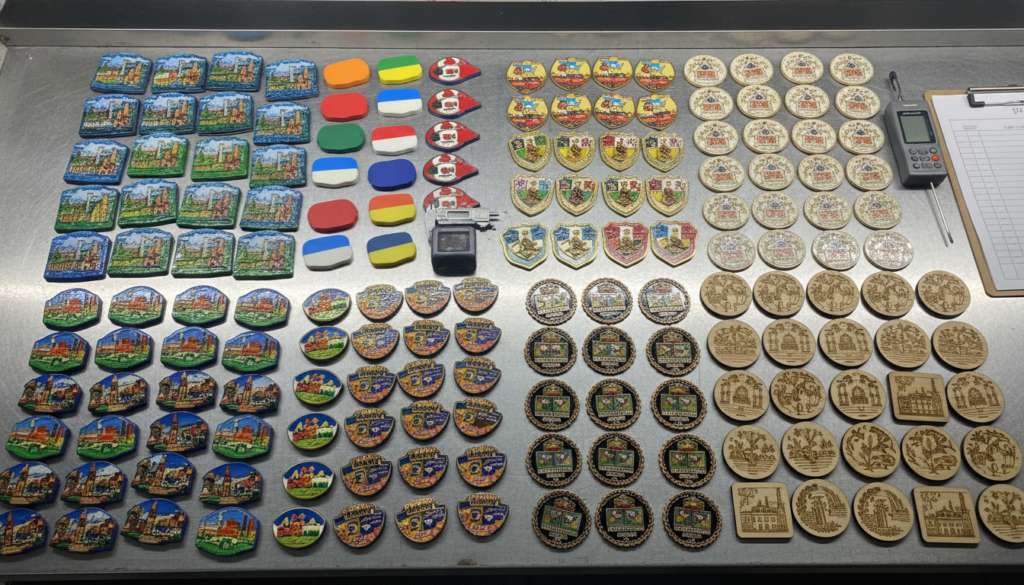
Planning a custom fridge magnets bulk order requires understanding the complete workflow from design brief to delivery, recognizing that minimum order quantities and production schedules vary by material (3D resin, soft PVC, metal, wood), and allowing time for design proof, physical sample approval, and pre-shipment inspection before bulk production begins.
📋 Table of Contents
Executive Summary
- Order workflow: Every custom fridge magnets bulk order follows design brief, quotation, artwork proof, physical sample approval, deposit, bulk production, pre-shipment inspection, and shipping.
- Material-specific minimums: Minimum order quantities differ by process and are confirmed at quotation; resin and soft PVC typically require lower minimums for simple shapes, while metal and wood may require higher minimums when new tooling is involved.
- Lead time components: Total time from order to delivery includes artwork revision cycles, sample production and approval, bulk production, quality inspection, and international freight; each stage is confirmed at quotation.
- Retail assortment: Souvenir shops typically order multiple designs in smaller quantities per SKU rather than single-design bulk, balancing inventory risk against per-unit cost.
- Quality checkpoints: Design proof, physical sample sign-off, and pre-shipment inspection reduce the risk of color mismatch, magnet strength issues, and packaging damage before goods leave the factory.

What is the complete order workflow for custom fridge magnets bulk?
The workflow begins when you submit a design brief and ends when inspected goods ship. Understanding each stage helps you plan realistic timelines and avoid delays caused by incomplete artwork or rushed approvals.
Design brief and quotation
You provide design files (vector artwork preferred), specify the material (3D resin, soft PVC, metal, or wood), size, and estimated quantity. The supplier reviews technical feasibility and returns a quotation covering unit price, tooling cost (if new molds are required), minimum order quantity, and estimated production schedule. Quotation turnaround is confirmed at the time of inquiry.
Buyers often submit multiple material options in the same brief to compare cost and visual effect. A design that works well in soft PVC may not translate cleanly to metal enamel, so requesting parallel quotes for different processes helps you choose the best fit before committing to tooling.
Artwork proof and revision
Once you accept the quotation, the supplier prepares a digital proof showing how your artwork will be rendered in the chosen material. This proof highlights color separations, layer depth (for resin), enamel boundaries (for metal), or engraving detail (for wood). You review and approve the proof or request revisions.
Most buyers need one to three revision cycles to finalize artwork. Common changes include adjusting text size for legibility, simplifying small details that cannot be molded cleanly, and correcting color codes to match brand guidelines. Each revision cycle adds time, so providing complete, print-ready artwork at the start shortens the approval phase.
Physical sample production and sign-off
After artwork approval, the supplier produces a physical sample using the actual mold and production process. This sample is the only way to verify that colors, relief depth, magnet strength, and finish quality meet your expectations before bulk production starts. You inspect the sample and either approve it or request adjustments.
In practice: Resin magnets are cast in multiple layers, so a physical sample reveals whether thin text lines and small color areas survive the pour and cure process before thousands of units are produced.
Sample production time and shipping time to your location are confirmed at quotation. Buyers outside Asia should account for international courier transit when planning approval deadlines.
Deposit, bulk production, and inspection
Once you approve the sample, you pay the deposit (terms confirmed at quotation) and bulk production begins. The supplier manufactures your order, applies quality checks during production, and conducts a pre-shipment inspection before packing. You receive inspection photos or a third-party report confirming that the bulk batch matches the approved sample.
Production duration depends on order quantity, material complexity, and factory schedule. Buyers ordering during peak seasons (spring for summer tourist destinations, autumn for winter holiday merchandise) should request quotations earlier to secure production slots.
Balance payment and shipping
After inspection approval, you pay the balance and the supplier arranges shipment. Freight options include air (faster, higher cost per unit) and sea (slower, lower cost per unit). The supplier provides commercial invoice, packing list, and shipping documents for customs clearance at your destination.
Landed cost includes the unit price, freight, customs duties, and VAT or GST. Buyers in the US, EU, Australia, Japan, and the UK should confirm Harmonized System (HS) codes and duty rates with their customs broker before finalizing the order to avoid budget surprises.
How do minimum order quantities differ by material?
Minimum order quantities vary by production process and are confirmed at quotation. Each material has different tooling requirements, production setup complexity, and unit economics that influence the minimum viable batch size.
Why resin and soft PVC often have lower entry points
Resin magnets use silicone molds that cost less to produce than steel injection molds or metal dies. Soft PVC injection molds are more expensive than resin molds but still moderate compared to metal tooling. Both processes allow relatively lower minimums for simple shapes, though exact quantities are confirmed at quotation.
Buyers testing a new design or entering a new destination market often start with resin or soft PVC to limit upfront investment. Once the design proves sell-through, they may reorder in metal for a premium product line or switch to wood for eco-conscious retail channels.
Why metal and wood may require higher minimums
Metal magnets use die-casting or stamping molds that involve higher tooling cost. Adding hard enamel, soft enamel, or multiple plating finishes increases setup complexity and pushes minimums higher. Wood magnets have lower tooling cost but may require higher minimums when UV printing involves many colors or when custom backing cards and retail packaging are included.
Museum stores and high-end gift shops often accept higher minimums for metal magnets because the premium finish and weight justify a higher retail price, improving margin per sale even if inventory turns more slowly.
Ordering multiple designs in one shipment
Many souvenir buyers order several designs in a single shipment to meet the supplier’s total-order minimum while keeping per-design quantities lower. For example, you might order four different landmark designs in the same material, each at a moderate quantity, rather than committing to a large quantity of a single design.
This approach spreads inventory risk and lets you test which designs sell fastest. Suppliers typically quote a combined minimum across all designs in the same material, though each design still requires its own mold.
What stages affect the total lead time?
Total lead time from order to delivery includes artwork revision, sample production and approval, bulk production, inspection, and freight. Each stage is confirmed at quotation, and delays in any one stage push back the final delivery date.
Artwork revision cycles
The time you take to review and approve artwork proofs directly affects the timeline. Buyers who provide print-ready vector files and approve the first proof within a business day move faster than those who request multiple color adjustments or redraw small details after seeing the proof.
Establishing clear artwork guidelines at the quotation stage reduces revision cycles. Specify Pantone or CMYK color codes, confirm minimum text height for legibility, and provide high-resolution logo files to avoid back-and-forth.
Sample production, shipping, and approval
After artwork approval, the supplier produces a physical sample and ships it to you for inspection. Sample production time and international courier transit are confirmed at quotation. Buyers in North America, Europe, or Australia should account for courier transit when planning approval deadlines.
Approving the sample quickly keeps the project on schedule. Requesting changes to the sample (color adjustment, magnet strength increase, finish modification) requires a new sample cycle, adding time and cost.
Bulk production duration
Bulk production starts after you approve the sample and pay the deposit. Production duration depends on order quantity, material complexity, and the factory’s current workload. Resin casting and curing, PVC injection and cooling, metal plating and enamel baking, and wood laser cutting and UV printing each have different cycle times.
Buyers ordering for seasonal peaks (summer tourism, winter holidays, national celebrations) should request quotations well in advance to secure production slots. Factories prioritize orders with confirmed deposits, so delaying sample approval can push your production window into a busier period.
Pre-shipment inspection and packing
After production, the supplier conducts a pre-shipment inspection to verify that the bulk batch matches the approved sample in color, relief depth, magnet strength, and finish quality. Inspection photos or a third-party report are sent to you for approval before packing.
Approving the inspection report quickly allows the supplier to pack and ship immediately. Requesting rework (re-plating a batch with incorrect finish, re-casting magnets with weak pull strength) delays shipment and may incur additional cost.
International freight and customs clearance
Freight time depends on shipping method (air or sea) and destination. Air freight is faster but costs more per unit; sea freight is slower but reduces per-unit landed cost for large orders. Customs clearance time varies by destination country and the completeness of your import documentation.
Buyers should confirm HS codes, duty rates, and any import restrictions (small-magnet safety regulations, wood treatment certificates) with their customs broker before the supplier ships. Missing or incorrect documentation can delay clearance and incur storage fees at the port.
How should you plan assortment quantities for retail?
Souvenir and gift shops rarely order a single design in large quantity. Instead, they plan assortments with multiple designs, balancing inventory risk, shelf variety, and per-unit cost.
Quantity per design based on sell-through targets
Calculate how many units of each design you expect to sell in a season or year. A landmark magnet in a high-traffic tourist shop may sell hundreds of units per month, while a niche design (historical figure, local festival theme) may sell dozens. Order quantities that cover your sell-through target plus a safety margin, but avoid over-ordering slow movers.
Buyers new to a destination or product category often start with lower quantities across more designs to test which themes resonate. After one season, they reorder top sellers in larger quantities and drop designs that did not move.
Seasonal replenishment and reorder planning
Tourist destinations have peak and off-peak seasons. Order enough inventory to cover the peak season without carrying excess stock into the off-season. Plan reorders based on actual sales data from the previous season, adjusting for growth or changes in visitor demographics.
Reordering the same design is faster than ordering a new design because the mold already exists. Suppliers typically waive or reduce tooling fees for repeat orders, lowering the per-unit cost and allowing smaller reorder quantities.
Packaging, barcodes, and carton planning
Retail-ready packaging (backing cards, polybags, barcode labels) must be planned at the quotation stage. Specify whether you need individual barcodes per design, a single UPC for the product line, or no barcodes (for independent gift shops that do not use point-of-sale scanners).
Carton planning affects freight cost and warehouse handling. Suppliers pack magnets in inner boxes (per design) and outer cartons (mixed designs). Confirm carton dimensions and weight to calculate container utilization for sea freight or pallet configuration for air freight.
Balancing cost per unit against inventory risk
Higher order quantities reduce per-unit cost because tooling and setup costs are spread over more units. However, ordering too many units of a single design ties up cash and risks unsold inventory if the design underperforms. Souvenir buyers typically accept a slightly higher per-unit cost in exchange for lower inventory risk and greater design variety.
Ordering multiple designs in moderate quantities also gives you flexibility to adjust your assortment based on real sales data, rather than committing to a single design that may or may not resonate with your customer base.
What quality controls protect bulk orders?
Buyers ordering custom fridge magnets bulk face risks including color mismatch, weak magnet strength, resin odor, PVC safety concerns, wood compliance issues, and packaging damage. Quality controls at each stage reduce these risks before goods ship.
Design proof and artwork approval
The digital proof shows how your artwork will be rendered in the chosen material, highlighting color separations, layer depth, enamel boundaries, or engraving detail. Approving the proof confirms that the design is technically feasible and that colors, text, and logos are positioned correctly.
Buyers should verify Pantone or CMYK codes at this stage to avoid color mismatches later. Resin and soft PVC allow more color flexibility than metal enamel, which uses pre-mixed paint batches that must match your specification exactly.
Physical sample sign-off
The physical sample is the only way to verify color accuracy, relief depth, magnet strength, and finish quality before bulk production. Inspect the sample under natural light to check color matching, test the magnet pull strength on a steel surface, and check for resin odor, PVC flexibility, or wood finish smoothness.
Requesting a sample revision (stronger magnet, deeper relief, matte finish instead of gloss) is straightforward at this stage. Making the same change after bulk production starts is costly and delays shipment.
Pre-shipment inspection
After bulk production, the supplier conducts a pre-shipment inspection to verify that the batch matches the approved sample. Inspection covers color consistency, magnet strength across the batch, surface finish, and packaging integrity. You receive inspection photos or a third-party report before the goods are packed.
Buyers can hire independent inspection companies (SGS, Bureau Veritas, Intertek) to conduct on-site inspections at the factory. Third-party inspectors check a random sample from the batch, measure magnet pull strength, verify packaging, and document any defects. This adds cost but provides an independent verification layer.
Material-specific compliance and testing
Different destination markets have different compliance requirements. Buyers should ask suppliers for current test reports at quotation and verify that the reports cover the exact material and coating used in their order.
- EN71 (Europe): Covers toy safety, including small-magnet regulations. Decorative magnets sold as non-toys may not require EN71, but buyers should confirm with their importer or legal advisor.
- REACH (Europe): Restricts heavy metals and certain chemicals in consumer products. Ask for a REACH compliance declaration and test report covering the metal alloy, paint, and coating.
- CPSIA (United States): Regulates lead and phthalates in children’s products. Magnets sold as toys or marketed to children must meet CPSIA limits; ask for test reports from an accredited lab.
- ASTM F963 (United States): Toy safety standard including small-parts and magnet-strength tests. Applies to magnets sold as toys; decorative magnets may be exempt.
- Proposition 65 (California): Requires warnings for products containing certain chemicals. Ask suppliers whether their materials trigger Prop 65 labeling requirements.
- LFGB (Germany): Covers food-contact materials. Magnets that touch food (refrigerator use) may require LFGB testing; ask suppliers for current reports.
Buyers should not assume that a supplier’s general certification applies to every material and coating. Request test reports specific to the resin formulation, PVC compound, metal alloy, enamel paint, plating finish, or wood treatment used in your order.
Packaging and transit protection
Magnets are prone to chipping, scratching, and magnetizing to each other during transit. Suppliers should pack each magnet in a polybag or backing card, separate designs in inner boxes, and cushion outer cartons with foam or bubble wrap. Specify packaging requirements at quotation to avoid receiving damaged goods.
Buyers shipping by sea should request moisture-barrier packaging (desiccant packs, sealed polybags) to prevent resin discoloration or wood warping in humid container environments. Air freight has shorter transit times and lower humidity risk but costs more per unit.
Key Takeaways
- Every custom fridge magnets bulk order follows a structured workflow: design brief, quotation, artwork proof, physical sample approval, deposit, bulk production, pre-shipment inspection, and shipping.
- Minimum order quantities differ by material and are confirmed at quotation; resin and soft PVC typically allow lower entry points for simple shapes, while metal and wood may require higher minimums when new tooling or complex finishes are involved.
- Total lead time includes artwork revision cycles, sample production and approval, bulk production, inspection, and international freight; each stage is confirmed at quotation, and delays in any one stage push back the final delivery date.
- Souvenir shops plan assortments with multiple designs in moderate quantities per SKU, balancing inventory risk against per-unit cost and allowing flexibility to adjust based on real sales data.
- Quality controls at each stage reduce risk: design proof confirms technical feasibility, physical sample sign-off verifies color and magnet strength, and pre-shipment inspection ensures the bulk batch matches the approved sample before goods ship.
- Buyers should request material-specific compliance test reports (EN71, REACH, CPSIA, ASTM F963, Prop 65, LFGB) at quotation and verify that reports cover the exact resin formulation, PVC compound, metal alloy, enamel paint, plating finish, or wood treatment used in their order.
Can I order multiple designs in one shipment to meet the minimum?
Yes, many suppliers allow you to combine multiple designs in the same material to meet the total-order minimum, though each design still requires its own mold. This approach spreads inventory risk and lets you test which designs sell fastest. Confirm combined-minimum policies at quotation, and verify that all designs ship together to avoid split-shipment freight charges.
What happens if the bulk batch does not match the approved sample?
If the pre-shipment inspection reveals color mismatch, weak magnet strength, or finish defects, you can request rework before shipment. The supplier should re-plate, re-cast, or re-finish the affected units at no additional cost if the defect is due to production error. Establish acceptable tolerance ranges (color variation, magnet pull strength) at sample approval to avoid disputes later. Third-party inspection reports provide independent documentation if rework is needed.
How do I calculate landed cost for my destination market?
Landed cost includes the unit price, international freight, customs duties, and VAT or GST. Request the supplier’s quotation with FOB or CIF terms, then add freight (air or sea), duty based on the HS code for your destination, and applicable taxes. Buyers in the US, EU, Australia, Japan, and the UK should confirm HS codes and duty rates with a customs broker before finalizing the order. Include these costs in your retail pricing calculation to ensure margin targets are met.
Ready to plan your custom fridge magnets bulk order with a supplier who provides design proof, physical sample sign-off, and pre-shipment inspection?
Request a Quote →
Written by the Magnista export team, who coordinate design proofs, sampling and production for custom souvenir magnets.