Small Magnet Safety Souvenirs: Toy vs Decorative Rules
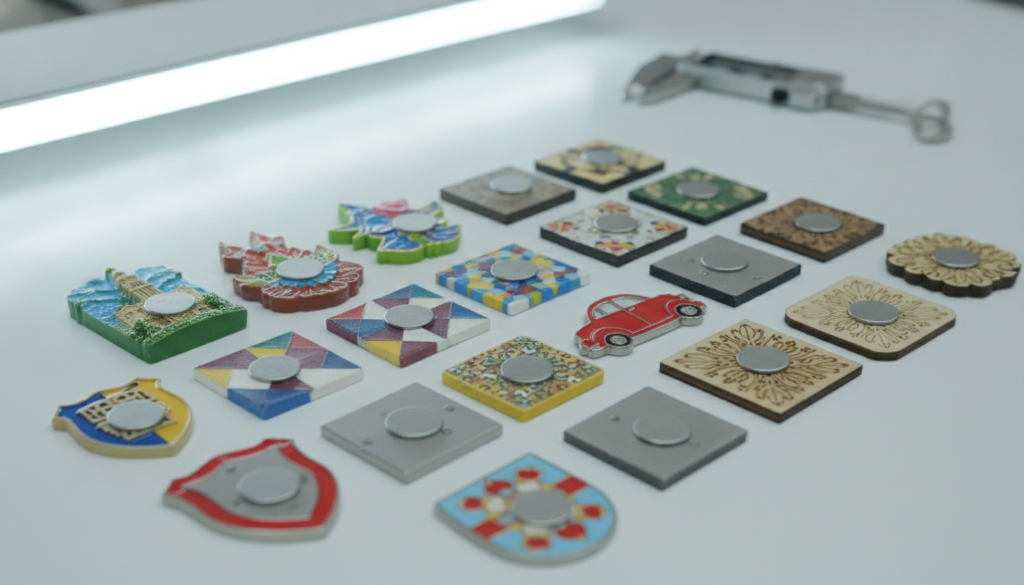
Small magnet safety souvenirs are regulated as toys when they’re marketed to children or incorporate play features, triggering ASTM F963 in the United States and EN71 in the European Union; otherwise they’re treated as general consumer products subject to CPSC high-powered magnet rules in the U.S. or national product-safety requirements elsewhere. The classification hinges on intended use, packaging, merchandising location, and whether the magnet can detach during foreseeable handling. Buyers sourcing 3D resin, soft PVC, metal, or wood magnets should request current test reports at quotation and verify that the supplier’s production process keeps magnets securely encapsulated throughout the product’s life.
📋 Table of Contents
- Executive Summary
- When Do Toy Safety Rules Apply to Souvenir Magnets?
- What Rules Govern Magnets Sold as Household Decorative Items?
- How Do You Classify a Souvenir Magnet as Toy or Decorative?
- Which Compliance Tests Apply to 3D Resin, Soft PVC, Metal, and Wood Magnets?
- How Do You Verify Supplier Compliance Before Ordering?
- What Risk Controls Should Retailers Implement?
- Key Takeaways
Executive Summary
- Classification determines the legal regime: A souvenir magnet marketed to adults and sold in the household-goods section faces different testing than one packaged as a children’s toy or sold near play items.
- Toy standards restrict small, detachable magnets: ASTM F963 and EN71 require that any magnet small enough to fit inside a small-parts cylinder either be too weak to attract through tissue or remain permanently fixed during abuse testing.
- General consumer products face high-powered magnet bans: The U.S. CPSC rule prohibits loose magnet sets with flux index above a threshold when marketed for entertainment or stress relief, but decorative fridge magnets are typically exempt if they remain attached to a substrate.
- Material type drives additional testing: Soft PVC and 3D resin magnets require phthalate and heavy-metal migration tests; metal magnets need lead and cadmium content checks; wood magnets must meet formaldehyde limits.
- Encapsulation is the primary safety control: Buyers report that substandard adhesive or uncoated neodymium magnets can result in peeling, rust, and potential safety hazards, so physical sample sign-off verifies that the magnet remains securely fixed during drop, pull, and torque tests before bulk production starts.
When Do Toy Safety Rules Apply to Souvenir Magnets?
Toy classification turns on intended use, not the product’s physical form. A refrigerator magnet becomes a toy when packaging, imagery, or merchandising suggests play, learning, or entertainment for children under fourteen years old. Regulators examine four factors: the product’s design appeal to children, any play features or interactive elements, the language and illustrations on packaging, and the retail location where it’s displayed.
Intended Use and Design Appeal
A magnet shaped like a cartoon character, puzzle piece, or alphabet letter signals child appeal even when the seller describes it as a souvenir. Bright primary colors, oversized eyes, and rounded proportions all push classification toward toy status. Conversely, a magnet depicting an architectural landmark in realistic detail and sold in a museum gift shop typically qualifies as a decorative household item. The distinction matters because toy rules impose stricter small-parts and magnet-retention requirements.
Packaging Language and Retail Placement
Packaging that includes age grading, educational claims, or child models triggers toy classification regardless of the manufacturer’s intent. Placement near children’s books, puzzles, or activity sets in a store reinforces that signal. Buyers who stock small magnet safety souvenirs in mixed-age retail environments should audit their shelf placement and ensure that packaging copy avoids phrases like “fun for kids” or “learning aid” unless the product has passed full toy testing.
ASTM F963 and EN71 Requirements for Toy Magnets
ASTM F963 Section 4.38 and EN71-1 Section 4.24 both require that any magnet or magnetic component that fits entirely inside a small-parts cylinder (approximately 3.17 cm deep by 3.17 cm diameter) must either have a flux index below 50 kG²mm² or remain inaccessible after a series of abuse tests. The abuse sequence includes drop tests from specified heights, torque tests applying rotational force, and tension tests pulling on accessible parts. A magnet that detaches during any of these tests causes the product to fail, and the batch cannot be sold as a toy.
According to Konsumentverket, strong magnets in toys must be too large for children to swallow and must not detach, while warning that non-toy items such as refrigerator magnets can still be dangerous when they contain small strong magnets. This guidance underscores that even household items require secure encapsulation when small magnets are present.
Health Canada advisory: Loose, swallowable powerful magnets can cause severe internal injury or death when multiple magnets are ingested and attract through tissue.
What Rules Govern Magnets Sold as Household Decorative Items?
Decorative fridge magnets fall under general consumer product safety rules. In the United States, the CPSC enforces a high-powered magnet rule targeting loose magnet sets marketed for entertainment, stress relief, or desk sculpture. The rule applies when individual magnets are small enough to fit in the small-parts cylinder and have a flux index above 50 kG²mm². However, magnets permanently affixed to a substrate, such as a 3D resin or soft PVC souvenir, are typically exempt because they are not loose and are not marketed for manipulation or assembly.
U.S. CPSC High-Powered Magnet Rule
The CPSC rule prohibits the manufacture, import, distribution, and sale of high-powered magnet sets that meet the size and strength criteria and are marketed for entertainment or stress relief. The rule does not ban all small strong magnets; it targets products where individual magnets can be removed and swallowed. A refrigerator magnet with a neodymium disc glued to a resin or PVC body remains legal provided the magnet cannot be pried off during normal handling. Buyers should request documentation showing that the magnet remains attached after pull and torque tests that simulate foreseeable misuse.
European Union General Product Safety Directive
In the EU, the General Product Safety Directive requires that all consumer products placed on the market are safe under normal and reasonably foreseeable conditions of use. National authorities in member states enforce this through market surveillance and can order recalls when magnets detach or when products pose a risk to children. EN71-1 applies only to toys, but authorities may apply the same technical criteria to non-toy products when a risk is identified. Buyers selling into multiple EU countries should ask suppliers for test reports covering magnet retention and, where relevant, phthalate and heavy-metal migration under EN71-3.
Canada, Australia, and Japan
Canada’s Toys Regulations under the Canada Consumer Product Safety Act mirror ASTM F963 magnet requirements for toys and extend similar hazard-assessment principles to non-toy consumer products. Australia enforces mandatory safety standards for toys and a general safety provision for other consumer goods; small strong magnets in any product must be assessed for child-access risk. Japan’s Food Sanitation Act and the Consumer Product Safety Act cover materials and general safety but do not have a specific high-powered magnet rule equivalent to the U.S. standard. Buyers exporting to Japan should verify that magnets remain fixed and that materials meet Japanese chemical-content limits.
How Do You Classify a Souvenir Magnet as Toy or Decorative?
Classification is a legal determination, not a design choice. Buyers must evaluate each product against regulatory criteria before finalizing packaging and merchandising plans. The following decision tree provides a practical framework.
Handling Gray-Area Products
Some magnets sit at the boundary: a stylized animal that appeals to both adults and children, or a magnet sold in a mixed-age gift shop. When classification is ambiguous, the safer course is to test the product as a toy and label it accordingly. Testing as a toy adds cost but eliminates the risk of a regulator later deeming the product a toy and ordering a recall. Buyers should discuss classification with their supplier at the quotation stage and request that the supplier provide written justification for the chosen classification along with supporting test reports.
Age-Warning Labels and Their Limits
Adding an age warning (“Not suitable for children under 3 years”) does not automatically convert a toy into a decorative item. If the product’s design, packaging, and merchandising still signal child appeal, regulators will classify it as a toy regardless of the warning. Age warnings are required on toys that contain small parts, but they do not exempt the product from toy-magnet retention requirements. Buyers should use warnings as a supplement to proper classification and testing, not as a substitute.
Which Compliance Tests Apply to 3D Resin, Soft PVC, Metal, and Wood Magnets?
Material composition determines which chemical-content and migration tests are mandatory. Every custom souvenir magnet range must meet the destination country’s chemical limits, and buyers should request current test reports for the exact materials used in their order.
3D Resin Magnets
Three-dimensional resin magnets are cast in multiple layers, creating relief and color separation. The resin itself must meet phthalate limits if the product is classified as a toy or a child-care article. In the United States, CPSIA prohibits phthalates above 0.1 percent by weight in toys and child-care articles. The EU restricts phthalates under REACH Annex XVII and EN71-3 for toys. Buyers should ask for test reports covering DEHP, DBP, BBP, DINP, DIDP, and DNOP. Heavy metals (lead, cadmium, mercury, chromium VI) must also be tested under EN71-3 migration limits or U.S. total-content limits. Resin magnets are cast in layers, so a physical sample is the only way to confirm that thin text and small color areas survive the pour before bulk production starts.
Soft PVC Magnets
Soft PVC (polyvinyl chloride) is injection-molded and delivers clean color blocks with a flexible, rubber-like feel. PVC historically contained phthalate plasticizers, and many jurisdictions now restrict or ban specific phthalates in consumer products. Buyers sourcing soft PVC magnets must verify that the supplier uses non-phthalate or compliant plasticizers and can provide test reports confirming that phthalate content is below regulatory thresholds. EN71-3 migration testing is required for toys sold in the EU, and CPSIA total-content testing is required for toys and child-care articles in the United States. Soft PVC magnets should also be tested for heavy-metal content, particularly lead and cadmium, which can be present in pigments and stabilizers.
Metal Magnets (Zinc Alloy and Brass)
Die-cast zinc alloy and stamped brass magnets are finished with enamel paint and plating. Lead and cadmium are the primary concerns: both metals can be present in alloys, solder, and surface coatings. The U.S. CPSIA limits lead content in children’s products to 100 ppm and surface coatings to 90 ppm. The EU restricts cadmium under REACH and lead under EN71-3 migration limits for toys. Buyers should request test reports for total lead and cadmium content in the base metal, any solder joints, and all surface finishes. Nickel release is also regulated in the EU for prolonged skin-contact items, though fridge magnets typically do not involve prolonged skin contact. Plating quality affects both appearance and safety: substandard plating can flake, exposing underlying metal and creating a sharp-edge hazard.
Wooden Magnets
Laser-cut and engraved wood magnets are finished with UV printing or screen printing. Formaldehyde is the primary chemical concern: wood composites and adhesives can emit formaldehyde, and some jurisdictions regulate formaldehyde content or emission levels. California Proposition 65 requires warning labels when formaldehyde exposure exceeds safe harbor levels. The EU restricts formaldehyde under REACH and classifies it as a carcinogen. Buyers should ask suppliers to specify the wood species and any composite materials used, and to provide formaldehyde test reports when required. Surface coatings (UV ink, screen-print ink, varnish) must also meet heavy-metal and phthalate limits. Wood magnets should be tested for splinter risk and edge sharpness, particularly after drop testing.
In practice: 3D resin magnets are cast in multiple layers, so color separation and fine detail depend on the precision of each pour; a physical sample verifies that registration and relief depth match the design proof before bulk production begins, eliminating the risk of blurred edges or color bleed that cannot be corrected after casting.
How Do You Verify Supplier Compliance Before Ordering?
Supplier verification starts with documentation requests and continues through physical sample testing. Buyers report that substandard adhesive or uncoated neodymium magnets can result in peeling, rust, and potential safety hazards, so every order should include a pre-production sample and a pre-shipment inspection to confirm that magnets remain securely attached.
Request Current Test Reports at Quotation
Ask the supplier for test reports covering the specific materials and processes used in your product. Reports should be dated within the past year and issued by an accredited third-party laboratory (ISO/IEC 17025 accreditation is the international standard). The report must list the exact product tested, the test methods used (ASTM F963, EN71, CPSIA, REACH), and the results for each parameter. Generic reports covering a different product or material are not sufficient. Buyers should verify that the report’s product description matches the quotation and that all relevant parameters are tested and pass.
Magnet Retention and Abuse Testing
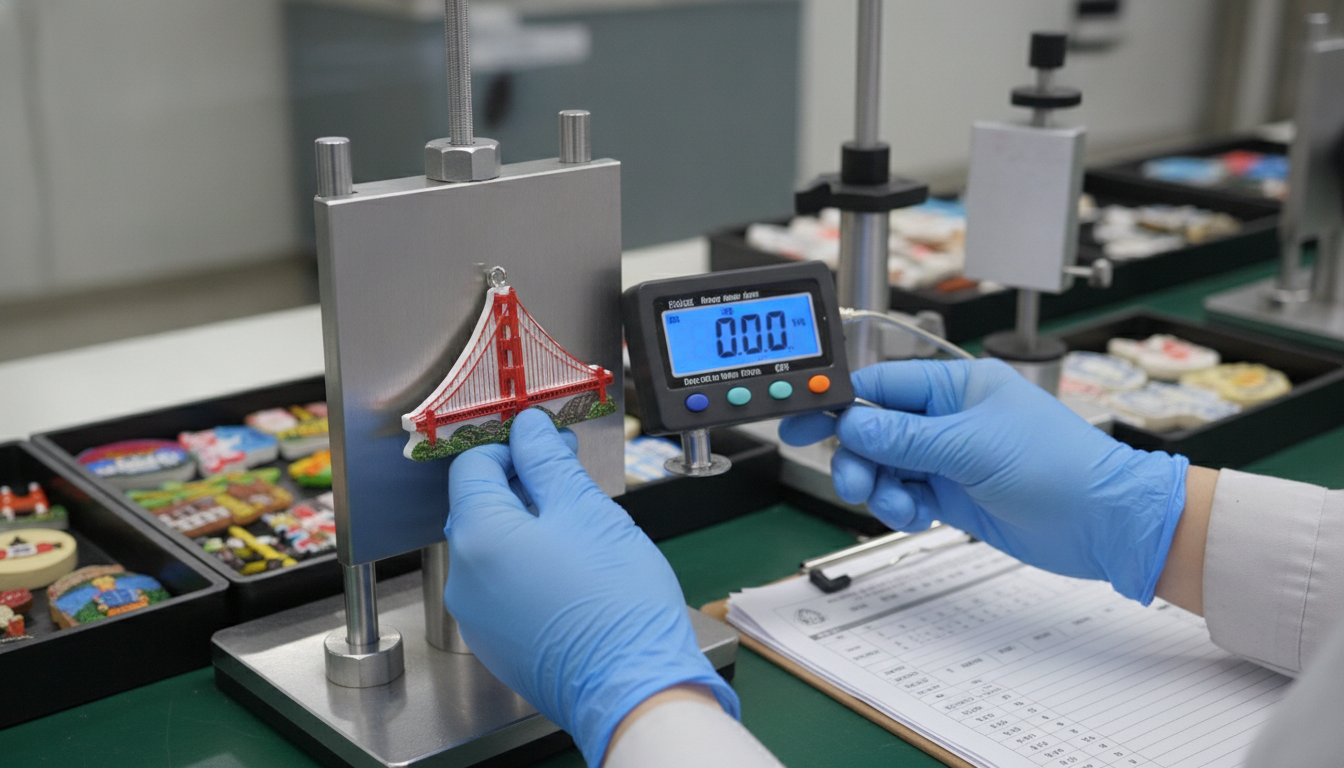
Magnet retention is the most critical safety parameter for small magnet safety souvenirs. The supplier should conduct pull tests, torque tests, and drop tests on pre-production samples and provide the results in writing. Pull tests apply a specified force (typically measured in newtons) perpendicular to the magnet surface; the magnet must not detach. Torque tests apply rotational force to any protruding part; again, the magnet must remain fixed. Drop tests simulate accidental falls from counter height onto a hard surface; the magnet must not crack, split, or detach. Buyers should request video documentation of these tests or arrange for an independent inspection agency to witness the tests before approving bulk production.
Supplier Declarations and Certificates of Conformity
A supplier declaration of conformity states that the product meets specified standards and regulations. In the EU, a Declaration of Conformity is a legal requirement for toys and many other products. The declaration must identify the product, list the applicable directives and standards, and be signed by an authorized representative of the manufacturer or importer. In the United States, a Children’s Product Certificate is required for products subject to CPSIA, and a General Certificate of Conformity may be required for other consumer products. Buyers should request these documents at quotation and verify that they are complete, accurate, and signed. A missing or incomplete declaration is a red flag indicating inadequate compliance controls.
Factory Audits and Third-Party Inspections
For larger orders or higher-risk products, buyers may arrange a factory audit or third-party inspection. An audit examines the supplier’s quality-management system, production processes, and compliance procedures. An inspection checks a sample of finished goods against the approved specification and conducts on-site testing of magnet retention, dimensions, and finish quality. Both services add cost but reduce the risk of receiving non-compliant goods. Buyers should specify the audit or inspection scope in the purchase order and make payment contingent on a satisfactory report. More guidance on verification steps is available on our quality and compliance page.
What Risk Controls Should Retailers Implement?
Retailers are legally responsible for the safety of products they sell, even when the manufacturer or importer provided compliance documentation. Effective risk controls include age-appropriate merchandising, staff training, damaged-product withdrawal, and recall procedures.
Age-Appropriate Merchandising and Signage
Place small magnet safety souvenirs in sections appropriate to their classification. Decorative magnets belong in household goods or adult gift areas, not in children’s sections or at child eye-level. Use shelf signage to reinforce age appropriateness: “Adult collectible” or “Not a toy” labels help customers and staff understand the product’s intended use. Avoid displaying magnets near children’s books, puzzles, or activity sets, as proximity can signal child appeal and increase the risk of a regulator classifying the product as a toy.
Staff Training on Magnet Hazards
Train retail staff to recognize magnet hazards and respond to customer questions. Staff should understand that swallowing multiple small strong magnets can cause intestinal blockage, perforation, or death, and that the hazard is not obvious to most customers. Staff should be able to explain why a product carries an age warning and direct customers to products that are tested and labeled as suitable for children when appropriate. Training should also cover how to identify damaged products and remove them from sale.
Damaged-Product Withdrawal and Inspection
Inspect magnets regularly for damage that could compromise safety. Cracks, chips, peeling, or rust indicate that the magnet may detach or that the encapsulation has failed. Remove damaged products from sale immediately and document the issue. Buyers may encounter magnets that slip or fail to hold enough material, making holding power and surface performance practical product concerns, but a magnet that detaches entirely is a safety hazard. Establish a clear procedure for staff to report and withdraw damaged goods, and track damage rates by supplier to identify quality issues early.
Recall Procedures and Traceability
Maintain records linking each batch of magnets to the supplier, production date, and test reports. Batch traceability enables a targeted recall if a safety issue is discovered. Retailers should have a written recall plan that includes customer notification, product return procedures, and communication with regulatory authorities. In the United States, the CPSC requires that firms report product hazards within specified timeframes; failure to report can result in penalties. In the EU, the RAPEX rapid-alert system tracks dangerous products, and retailers must cooperate with national authorities during recalls. Traceability and recall readiness are not optional; they are legal obligations in most jurisdictions.
Key Takeaways
- Souvenir fridge magnets are classified as toys when packaging, design, or merchandising signals child appeal, triggering ASTM F963 in the United States and EN71 in the European Union; otherwise they fall under general consumer product safety rules.
- ASTM F963 and EN71 require that small magnets in toys either remain permanently fixed during abuse testing or have a flux index below 50 kG²mm², and any magnet that detaches during drop, torque, or tension tests causes the product to fail.
- The U.S. CPSC high-powered magnet rule prohibits loose magnet sets marketed for entertainment or stress relief, but magnets permanently affixed to a substrate such as a 3D resin or soft PVC souvenir are typically exempt.
- 3D resin and soft PVC magnets require phthalate and heavy-metal testing under CPSIA and EN71-3; metal magnets need lead and cadmium content checks; wood magnets must meet formaldehyde limits and surface-coating restrictions.
- Buyers should request current test reports, magnet-retention test results, and supplier declarations at quotation, and arrange physical sample sign-off and pre-shipment inspection to verify that magnets remain securely attached during foreseeable use and abuse.
- Retailers must implement age-appropriate merchandising, staff training on magnet hazards, damaged-product withdrawal procedures, and batch traceability to enable targeted recalls when safety issues are discovered.
Are refrigerator magnets safe for children?
Refrigerator magnets are safe for children only when they are large enough that no component can fit inside a small-parts cylinder, or when any small magnet is permanently fixed and cannot detach during abuse testing. Magnets marketed as household decorative items are not automatically safe merely because they are not labeled as toys; buyers should verify that small strong magnets remain securely encapsulated and that the product carries appropriate age warnings when any small-parts hazard exists.
What happens if a child swallows a small magnet?
Swallowing a single small magnet typically passes through the digestive system without injury, but swallowing multiple strong magnets is a medical emergency because the magnets can attract through tissue, causing intestinal blockage, perforation, sepsis, or death. Symptoms may not appear for hours or days, and by the time pain or vomiting occurs, significant internal damage may have occurred. Immediate medical evaluation and imaging are required whenever multiple magnet ingestion is suspected, and surgery is often necessary to remove the magnets and repair damaged tissue.
How strong can a small magnet be before it becomes dangerous?
A small magnet becomes dangerous when it is small enough to be swallowed (fits entirely inside a small-parts cylinder approximately 3.17 cm deep by 3.17 cm diameter) and has a flux index above 50 kG²mm², which is strong enough to attract through intestinal tissue when multiple magnets are ingested. Toy standards in the United States and the European Union use this threshold to determine when magnet-retention requirements apply, and the U.S. CPSC high-powered magnet rule uses the same criteria to regulate loose magnet sets marketed for entertainment or stress relief.
Need compliant souvenir magnets with verified retention testing?
Request Test Reports and a Quote →
Written by the Magnista export team, who coordinate design proofs, sampling and production for custom souvenir magnets.