What Affects Custom Fridge Magnet Minimum Order? (2026 Guide)
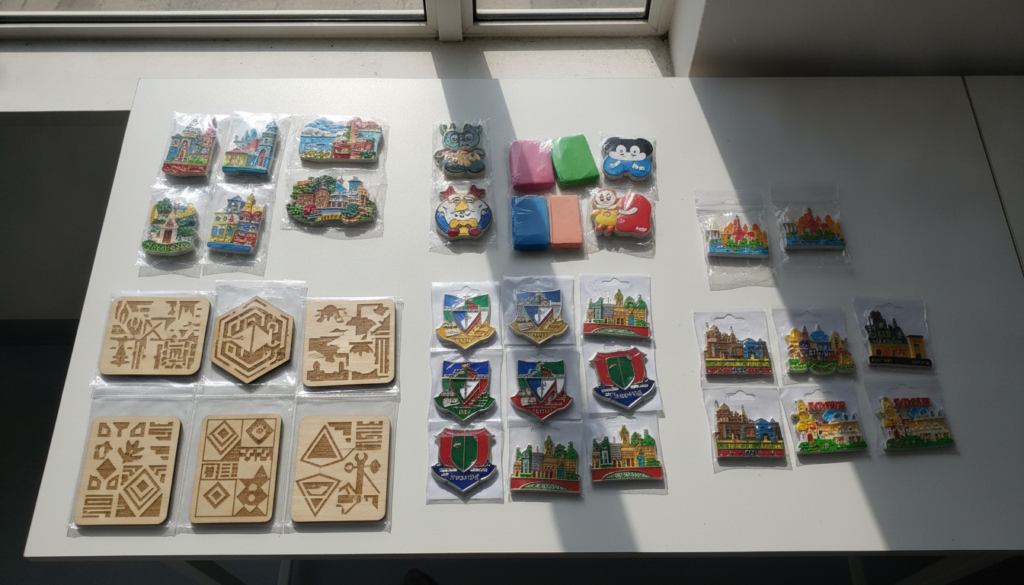
The custom fridge magnet minimum order is determined by the production process (3D resin, soft PVC, metal or wood), mold or tooling requirements, design complexity, color count, and packaging specifications. Each process has different setup economics: molded products require new tooling for each shape, while engraved or printed processes may share base materials across designs.
Key Takeaways
- Process dictates setup cost: 3D resin and soft PVC require individual molds for each unique shape, while metal die-casting uses shared dies for standard outlines and wood uses shared blanks.
- Design count affects the minimum: ordering multiple designs in one purchase order spreads tooling investment but raises the total piece count needed to reach viable production runs.
- Color and detail complexity: multi-layer resin relief, gradient fills and hand-painted accents increase labor per piece, which can push minimums higher to cover setup and training time.
- Packaging and retail readiness: custom backing cards, barcodes, retail hangers and shrink-wrap add steps and materials, raising the threshold at which unit economics work.
- Reorder flexibility: buyers often start with a mixed assortment to test retail performance, then reorder top sellers at lower per-design minimums once molds are paid.
- Landed cost matters more than unit price: a lower quoted minimum may cost more per delivered piece after tooling, freight, duties and compliance testing are factored in.
📋 Table of Contents
- Key Takeaways
- Which production process sets the baseline minimum?
- How do tooling and molds affect the order threshold?
- Does design complexity change the minimum order?
- Can I order multiple designs in one purchase?
- How does packaging affect the minimum?
- What is the real cost per piece after freight and duties?
- What minimum applies to reorders?

Which Production Process Sets the Baseline Minimum?
The production method determines setup investment and labor intensity, which in turn set the economic floor for a viable run. Molded processes require dedicated tooling; engraved and printed processes share base materials but still need artwork setup and test runs.
3D Resin Molding
3D resin magnets are cast in silicone or rubber molds, with each color layer poured and cured separately. A new mold is cut for every unique shape, and complex relief details require hand-finishing after demolding. Setup includes mold fabrication, color formulation and test pours to confirm that thin lines, small text and tight color boundaries survive the casting process. Because each design needs its own mold and the labor per piece is higher than injection molding, the minimum reflects mold amortization and batch efficiency.
Soft PVC Injection Molding
Soft PVC magnets are injection-molded in steel molds with cavities for each color area. The mold is machined to the exact outline and relief depth of the design, and liquid PVC is injected into each cavity in sequence. Setup cost is dominated by mold machining, and the molding cycle is faster than resin casting, but every unique shape still requires a dedicated mold. The minimum order for soft PVC reflects mold cost and the batch size needed to justify machine time and material waste during color changes.
Metal Die-Casting and Stamping
Metal magnets are produced by die-casting zinc alloy or stamping brass, then finished with enamel paint, screen printing or electroplating. Die-cast magnets require a steel die for each unique outline, but standard shapes (circles, rectangles, shields) can share a die and differentiate through surface artwork. Stamped magnets use a cutting die for the outline and a separate die for embossed or debossed details. Enamel paint is applied by hand or screen, and plating adds another process step. The minimum order reflects die cost, plating-bath setup and the labor required for multi-color enamel filling.
Wood Laser Engraving and UV Printing
Wooden magnets are laser-cut from sheet material (birch plywood, bamboo or MDF) and finished with laser engraving, UV printing or both. Laser cutting uses a digital file, so no physical die is needed, and multiple designs can be nested on one sheet to minimize waste. UV printing applies full-color artwork directly to the wood surface, and engraving adds tactile depth. Setup is limited to file preparation and test cuts, so the minimum order is lower than molded processes, but the material cost per piece is higher and large orders may require multiple sheets and extended machine time.
Magnista produces magnets in all four processes to your specification: 3D resin, soft PVC, metal and wood. The production partner confirms the minimum at quotation based on your chosen process, design count and packaging requirements.
How Do Tooling and Molds Affect the Order Threshold?
Tooling is the largest fixed cost in custom magnet production. A mold or die must be fabricated before the first piece can be made, and that cost is spread across the order quantity. Smaller orders carry a higher per-piece tooling burden, which is why suppliers quote minimums that make the unit economics viable for both parties.
Mold Fabrication for Resin and PVC
Silicone molds for resin casting are hand-cut or CNC-machined from a master model, and each mold has a limited lifespan measured in casting cycles. Steel molds for soft PVC are CNC-machined with precision cavities and gates, and they last for tens of thousands of cycles. The fabrication time and material cost differ by an order of magnitude, which is why soft PVC minimums reflect higher upfront mold investment but lower per-piece cost at scale. Resin molds are cheaper to produce but wear faster, so reorder runs may require a replacement mold if the original has degraded.
Die Tooling for Metal Magnets
Die-cast magnets require a steel die machined to the outline and relief of the design. The die is mounted in a casting machine, and molten zinc alloy is injected under pressure. Die machining takes longer than silicone mold cutting, and the steel itself is more expensive, but a well-maintained die can produce hundreds of thousands of pieces without degradation. Stamped magnets use a cutting die and, if embossed details are required, a forming die. Both are machined from tool steel and have similar longevity. The minimum order reflects die cost and the setup time required to mount, test and adjust the die on the press.
Digital Tooling for Wood and Printed Magnets
Laser-cut wood magnets use a digital cutting file, so there is no physical die to fabricate. Setup is limited to file conversion, test cuts to confirm kerf and burn depth, and material loading. UV printing uses a digital file and requires no screen or plate, but the printer must be calibrated for the wood surface and ink adhesion tested. Because tooling cost is near zero, the minimum order is driven by material efficiency (nesting multiple designs on one sheet) and machine time rather than amortization of a physical mold or die.
In practice: A 3D resin magnet with raised text and a gradient background requires a multi-cavity silicone mold and separate color pours, so the physical sample is the only way to confirm that the text edges stay sharp and the gradient transitions smoothly before committing to bulk production.
Does Design Complexity Change the Minimum Order?
Yes. Designs with fine detail, multiple colors, hand-painted accents or assembly steps require more labor per piece, which raises the threshold at which the order becomes economically viable. Simple single-color designs with bold outlines can be produced efficiently at lower quantities because setup and per-piece labor are minimal.
Color Count and Layer Separation
Each color in a resin or PVC magnet requires a separate pour or injection cycle. A two-color design needs two mold fills, and the first layer must cure or cool before the second is added. A five-color design multiplies labor and cycle time by five, and any misalignment between layers creates scrap. The minimum order rises with color count because the per-piece labor cost increases and the risk of defects grows. Metal magnets with multiple enamel colors face the same dynamic: each color is applied and cured separately, and hand-filling small areas is slow and error-prone.
Relief Depth and Undercuts
3D resin magnets with deep relief or undercut details require flexible molds that can be peeled away without damaging the casting. Deeper relief increases material volume and cure time, and undercuts make demolding harder, which slows production and raises the scrap rate. Soft PVC molds cannot accommodate true undercuts because the rigid mold must open cleanly, so designs are limited to draft angles that allow ejection. Metal die-cast magnets can achieve sharper undercuts than PVC, but they require side-action cores in the die, which add cost and complexity. The minimum order reflects the mold difficulty and the slower cycle time for complex relief.
Hand-Painted Accents and Assembly
Some designs require hand-painted details (eyes, highlights, fine lines) or multi-part assembly (separate magnet backing, glued-on components, inserted rhinestones). Hand labor is the largest variable cost in custom magnet production, and it scales linearly with order quantity. The minimum order for hand-finished magnets is higher because the per-piece cost is higher and the supplier needs a larger batch to justify training workers and setting up the finishing line.
Can I Order Multiple Designs in One Purchase?
Yes, and it is common for souvenir shops and museum stores to order an assortment of designs in a single purchase order. However, the total piece count across all designs must still meet the supplier’s minimum threshold, and each unique shape typically requires its own mold or die, so the per-design minimum applies within the overall order.
Per-Design Minimum vs. Total Order Minimum
Suppliers quote minimums in two ways: per design (each unique shape or artwork must meet a minimum piece count) or per order (the total across all designs must meet a minimum, but individual designs can fall below it). Per-design minimums are common for molded products because each design requires its own tooling, and the supplier cannot amortize mold cost across a mixed order. Per-order minimums are more common for printed or engraved products where tooling is digital and multiple designs can be produced in one setup. Ask the supplier at quotation whether the minimum applies per design, per colorway, or across the entire purchase order.
Assortment Strategy for Retail Testing
Tourist attraction retailers often start with a mixed assortment to test which designs sell best, then reorder top performers at higher quantities. The initial order spreads risk across multiple designs, but the total piece count is higher because each design must meet its individual minimum. Once sales data is available, reorders can focus on proven sellers, and the per-design minimum may be lower because the mold or die is already paid for. This two-phase strategy balances upfront investment with retail flexibility, but it requires a higher initial commitment than ordering a single design.
Shared Tooling for Standard Shapes
Metal magnets with standard outlines (circles, rectangles, shields) can share a die and differentiate through surface artwork (enamel colors, screen printing, laser engraving). This allows buyers to order multiple designs at lower per-design minimums because the die cost is shared. Soft PVC and resin magnets with identical outlines but different relief details or color schemes still require separate molds because the cavity itself defines the design. Wood magnets can nest multiple designs on one sheet, so the per-design minimum is driven by material efficiency rather than tooling cost.
How Does Packaging Affect the Minimum?
Retail-ready packaging adds material cost, labor and quality-control steps, all of which raise the minimum order threshold. Bulk packaging (poly bags, generic cartons) is the baseline; custom backing cards, barcodes, shrink-wrap and retail hangers increase the per-piece cost and the setup required to produce them.
Custom Backing Cards and Barcodes
Museum stores and gift shops often require magnets mounted on printed backing cards with product information, barcodes and branding. The backing card is printed separately, die-cut to shape, and the magnet is attached with adhesive or a blister pack. Printing setup includes plate or screen fabrication, color proofing and die-cutting setup, and each design may need a unique card layout. The minimum order reflects printing setup cost and the batch size required to justify a press run. Barcode printing adds a variable-data step, and if each SKU requires a unique UPC, the supplier must coordinate barcode assignment and printing accuracy.
Shrink-Wrap and Retail Hangers
Shrink-wrapping individual magnets or card-mounted sets adds a heat-sealing step and material cost. Retail hangers (euro slots, J-hooks, adhesive hangers) require either die-cut slots in the backing card or separate plastic hangers attached during assembly. Both add labor and slow throughput, which raises the minimum order needed to cover setup and training time. Buyers who need retail-ready packaging should specify it at quotation, because the minimum for carded, shrink-wrapped magnets with hangers is higher than the minimum for bulk-packed magnets.
Inner Cartons and Master-Carton Labeling
Magnets are packed in inner cartons (dozens or half-dozens) and then into master cartons for shipping. Retail buyers often specify inner-carton quantities that match their shelf-replenishment unit, and master cartons must carry product labels, barcodes and compliance marks. Custom inner-carton printing and labeling add setup cost, and the minimum order must align with carton multiples to avoid partial boxes and wasted material. Suppliers typically quote minimums in full-carton increments, so a design with a per-carton count that does not divide evenly into the buyer’s target quantity will round up to the next full carton.
- Poly-bag bulk packing: lowest cost, no printing setup, suitable for buyers who repackage or sell loose
- Printed backing card: adds printing setup, die-cutting and adhesive assembly; requires artwork approval and color proof
- Barcode and UPC: variable-data printing, coordination with buyer’s SKU system, accuracy check before bulk run
- Shrink-wrap: heat-sealing equipment, film cost, slower throughput, quality check for seal integrity
- Retail hanger: die-cut slot or attached plastic hanger, additional assembly step, hanger material cost
What Is the Real Cost Per Piece After Freight and Duties?
The quoted unit price is only part of the total landed cost. Tooling, freight, import duties, compliance testing and payment fees all add to the per-piece cost, and a lower minimum with a higher unit price may deliver a better landed cost than a higher minimum with a lower unit price once all expenses are factored in.
Tooling Amortization Across Order Quantity
Mold and die costs are typically billed as a one-time charge on the first order, then amortized across the order quantity to calculate the effective unit cost. A mold that costs a certain amount and is spread across a smaller quantity adds more per piece than the same mold spread across a larger quantity. Buyers comparing quotes should calculate the all-in unit cost (tooling divided by quantity, plus unit price) rather than comparing unit prices alone. Reorders do not carry tooling cost, so the per-piece price drops, but the supplier may charge a mold-storage or refurbishment fee if the mold has been idle for an extended period.
Freight, Duties and Compliance Testing
Ocean freight is billed by container (full-container load or less-than-container load), and the per-piece freight cost falls as order quantity rises. Air freight is faster but costs more per kilogram, and it makes economic sense only for urgent or high-value orders. Import duties on magnets vary by material and country of import; the Harmonized Tariff Schedule classifies magnets under different codes depending on whether they are plastic, metal or wood, and duty rates range from zero to double digits. Compliance testing (CPSIA for children’s products in the US, EN71 for toys in the EU, REACH for materials sold in Europe) is a fixed cost per design or material batch, and it adds to the landed cost regardless of order quantity. Buyers should request a landed-cost breakdown at quotation, including tooling, freight (ocean or air), duties, testing and any agent or inspection fees.
Payment Terms and Currency Risk
Suppliers typically quote in US dollars and require a deposit before production starts, with the balance due before shipment or against a copy of the bill of lading. Wire-transfer fees, currency conversion and exchange-rate fluctuations add cost, and buyers paying in a currency other than the quote currency bear the exchange risk between deposit and final payment. Letter-of-credit terms add bank fees and document-handling charges. The effective per-piece cost includes all these fees, and they should be factored into the landed-cost comparison when evaluating quotes from multiple suppliers.
What Minimum Applies to Reorders?
Reorder minimums are typically lower than first-order minimums because tooling is already paid for and the supplier has a proven production file and quality standard. However, the minimum still reflects batch efficiency, material purchasing and machine setup, so it is not zero.
Mold Reuse and Storage
Suppliers store molds for active customers, but storage space is limited and molds degrade over time. Silicone molds for resin casting may last only a certain number of cycles before detail loss or tearing requires a replacement mold. Steel molds for soft PVC and metal die-cast magnets last much longer, but they may require cleaning, polishing or minor repair before reuse. Suppliers typically offer lower reorder minimums if the mold is in good condition and the reorder follows within a reasonable timeframe (six to twelve months). If the mold has been stored for years or has degraded, the supplier may charge a refurbishment fee or require a new mold, which raises the reorder minimum back to first-order levels.
Material Purchasing and Batch Efficiency
Resin, PVC, metal alloy and wood are purchased in bulk, and suppliers negotiate better pricing at higher volumes. A reorder that is too small to justify opening a new material batch or setting up a machine run may be declined or quoted at a higher unit price. The reorder minimum reflects the smallest batch size that makes economic sense for the supplier, and it varies by material and production process. Buyers planning regular reorders should ask the supplier for a reorder-minimum schedule at the time of the first order, so they can plan inventory replenishment around viable batch sizes.
Seasonal Demand and Lead-Time Planning
Tourist attractions and souvenir shops experience seasonal demand peaks (summer, holidays, school breaks), and reorder lead times can stretch during high season when factories are at capacity. Buyers who wait until stock is nearly depleted may face longer lead times or higher minimums because the supplier prioritizes larger orders during peak periods. Planning reorders during the shoulder season (late fall, early spring) often delivers shorter lead times and more flexible minimums because factory capacity is available and suppliers are willing to accept smaller batches to keep production lines running.
- Mold in good condition, reorder within twelve months: lower minimum, no tooling charge, faster turnaround
- Mold requires refurbishment or has been idle for years: refurbishment fee or new-mold charge, higher minimum
- Reorder during peak season: longer lead time, higher minimum or priority fee
- Reorder during shoulder season: shorter lead time, more flexible minimum, better negotiating position
- Material batch efficiency: reorder quantity should align with supplier’s material-purchasing increments to avoid waste surcharges
Magnista coordinates design proofs, sampling and production for custom souvenir magnets through a production partner in China. Every order goes through a design proof, physical sample sign-off and pre-shipment check before bulk production. The custom fridge magnet minimum order is confirmed at quotation based on your chosen process (3D resin, soft PVC, metal or wood), design count, complexity and packaging requirements. Tooling, freight, duties and compliance testing all affect the landed cost per piece, and reorder minimums are lower once molds are paid for and quality standards are proven.
Ready to confirm the minimum order and landed cost for your custom souvenir magnets?
Request a Quote →
Written by the Magnista export team, who coordinate design proofs, sampling and production for custom souvenir magnets.