How to Stop Fridge Magnets Breaking or Detaching in Transit
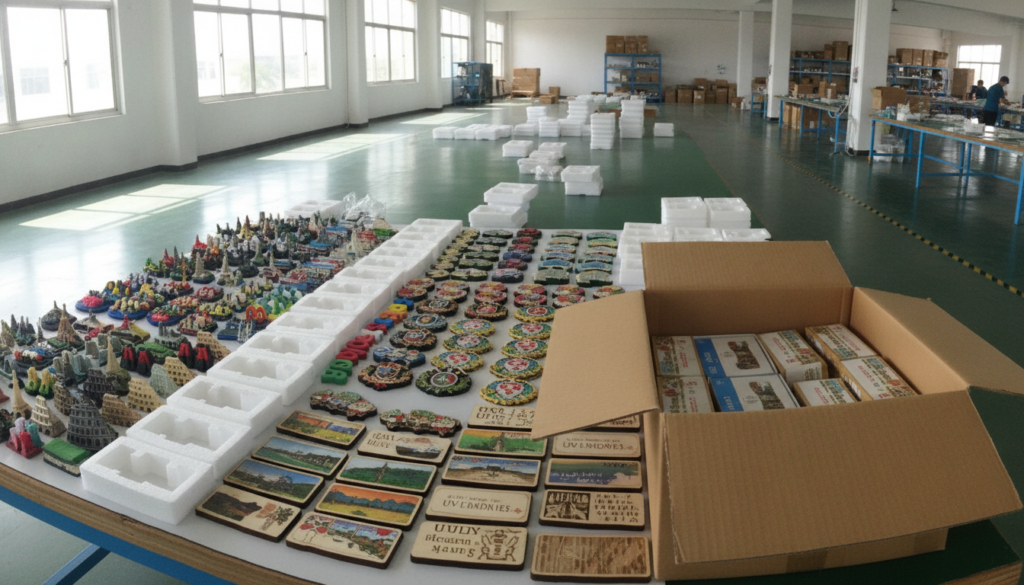
To prevent fridge magnets breakage shipping failures, match your packaging specification to the material, 3D resin requires individual foam compartments or molded cushioning, soft PVC tolerates lighter wrap, metal needs scratch protection, and wood demands moisture barriers, then require documented carton drop tests, adhesive pull-force testing, and pre-shipment photographs before the container leaves port. Every order goes through a design proof and a physical sample sign-off before bulk production.
📋 Table of Contents
- Executive Summary
- What Transit Risks Does Each Magnet Material Face?
- How Do You Specify Packaging That Prevents Breakage?
- Why Do Magnets Detach During Shipping and How Do You Stop It?
- What Carton Tests Should You Require Before Shipment?
- How Do You Verify Packaging and Adhesion Before the Container Leaves?
- Key Takeaways
Executive Summary
- Material determines packaging intensity: 3D resin magnets require individual foam compartments to protect raised relief and prevent edge cracks, while soft PVC tolerates lighter poly-bag wrap because the material flexes rather than shatters.
- Magnet detachment is an adhesive-process failure: Pull-force testing before packing catches weak bonds caused by oily surfaces, incomplete curing, or mismatched adhesive chemistry for the substrate.
- Carton drop tests are not optional: A documented drop from typical handling height onto each corner, edge, and face reveals whether inner packaging holds pieces stationary or allows collision damage.
- Pre-shipment photographs close the verification gap: Request images of the opened master carton, inner-box arrangement, individual wrapping, and a random sample pull-force demonstration before the freight forwarder takes possession.

What Transit Risks Does Each Magnet Material Face?
Each material used in custom souvenir magnet production responds differently to the compression, vibration, and impact cycles of ocean freight and last-mile delivery. Specifying packaging without understanding the material’s failure mode leads to predictable losses.
3D Resin: Edge Cracks and Relief Damage
Three-dimensional resin magnets are cast in layers, building relief detail through successive pours of colored polyresin. The raised surfaces and thin edges are brittle. Buyers report receiving resin magnets with crinkled and cracked edges, chipped paint on high points, and fractured relief details when pieces shift inside the carton and collide. Individual foam compartments or vacuum-formed polystyrene trays prevent movement. Bubble wrap alone is insufficient because it compresses under carton stacking, allowing the magnets to contact one another.
In practice: Resin magnets are cast in layers, so a physical sample is the only way to confirm that thin text and small color areas survive the pour and that edges resist chipping under handling stress before bulk production starts.
Soft PVC: Deformation and Color Transfer
Soft PVC magnets are injection-molded rubber. The material flexes rather than cracks, but sustained compression from carton stacking can deform fine details, flatten raised logos, or leave permanent creases. Color transfer occurs when dark PVC touches light PVC under pressure, especially in humid containers. Poly bagging each piece and inserting corrugated dividers every layer prevents contact and distributes compression load across the carton rather than concentrating it on individual magnets.
Metal: Scratched Plating and Bent Sections
Die-cast zinc alloy and stamped brass magnets carry electroplated finishes, gold, silver, antique bronze, nickel, that scratch easily. Thin sections, such as filigree borders or narrow text strokes, bend under point loads. Tissue interleaving or thin foam sheets between each magnet protect plating. A rigid inner box prevents the carton walls from flexing inward and concentrating pressure on the stack. Loose packing allows magnets to slide and abrade one another during transport.
Wood: Moisture, Warping, and Grain Splitting
Laser-cut wood magnets absorb moisture from humid air inside shipping containers, causing the grain to swell, warp the backing, and in extreme cases split along the cut edge. A vapor-barrier poly bag and a silica-gel sachet in each master carton maintain low humidity. UV-coated wood resists moisture better than raw or oil-finished surfaces, but the coating must cover all edges, not just the printed face, to block absorption.
How Do You Specify Packaging That Prevents Breakage?
Generic instructions such as ‘pack securely’ or ‘use bubble wrap’ leave the supplier to interpret your tolerance for fridge magnets breakage shipping losses. A written packaging specification removes ambiguity and creates an enforceable standard.
Individual Wrapping: Material and Thickness
State the wrapping material by name and minimum thickness. For resin magnets, specify closed-cell polyethylene foam sheet at a minimum thickness that prevents edge contact when stacked. For soft PVC, a poly bag per piece is sufficient if the bag is sealed to prevent dust and color transfer. For metal, tissue paper or foam interleaf must separate each magnet. For wood, the poly bag must be a vapor barrier, not generic LDPE, and the bag must be heat-sealed, not folded and taped.
Inner-Box Dividers and Layer Separation
Master cartons often hold multiple inner boxes. Each inner box should contain a single layer of magnets, separated by a corrugated divider or a foam sheet, so that the weight of upper layers does not compress lower layers. Specify the inner-box material, single-wall corrugated for light magnets, double-wall for resin or metal, and the maximum number of pieces per inner box. Overfilled inner boxes bulge, reducing the stacking strength of the master carton.
Master Carton Construction and Stacking Limits
The master carton must withstand the compression load of a stacked container without collapsing. Specify the carton material by bursting strength or edge-crush test value, not just ‘export carton.’ State the maximum stacking height in cartons, not weight, because freight handlers stack by count, not scale. A carton rated for five-high stacking that is loaded eight-high will crush, compressing the inner packaging and breaking the magnets inside.
Palletization and Strapping
Cartons loaded on pallets experience less handling abuse than floor-loaded cartons. Specify whether the shipment must be palletized and whether the pallet should be stretch-wrapped, banded, or both. Strapping prevents cartons from shifting during transport, but over-tight strapping can crush the top and bottom cartons. Request corner boards between the strap and the carton to distribute pressure.
Why Do Magnets Detach During Shipping and How Do You Stop It?
A magnet that separates from the souvenir body in transit arrives as two useless pieces. Buyers report receiving units with no magnet attached, duplicates with the magnet missing from one piece, and magnets rattling loose inside the poly bag. Detachment is not a packaging failure; it is an adhesive-process failure that packaging cannot fix.
Adhesive Selection: Match Chemistry to Substrate
The adhesive must bond the magnet material to the souvenir-body material. Two-part epoxy works for resin-to-magnet and metal-to-magnet bonds. Hot-melt adhesive is faster but weaker and fails in high-temperature containers. Pressure-sensitive adhesive tape is convenient but peels under sustained pull force. For soft PVC, the flexible magnet sheet is often molded into the back of the piece during injection, eliminating the adhesive joint entirely. For wood, the magnet is glued to the UV-coated back after printing; the coating must be roughened or the adhesive will bond to the coating, not the wood, and the coating will delaminate.
Surface Preparation: Clean, Dry, and Roughened
Oil, mold-release agent, dust, and moisture prevent adhesive from wetting the surface and forming a mechanical bond. Metal magnets fresh from plating carry a thin oil film that must be wiped with solvent before gluing. Resin magnets demolded without cleaning retain release agent on the back surface. Wood magnets cut with a laser have a carbon residue along the edge that blocks adhesion. Specify that both the magnet back and the souvenir-body bonding surface must be cleaned and dried, and that glossy surfaces must be lightly abraded with sandpaper or a Scotch-Brite pad to increase surface area.
Curing Time and Handling Interval
Adhesive requires time to reach full bond strength. Two-part epoxy may feel dry to the touch within minutes but requires overnight curing to develop shear and peel resistance. If magnets are packed immediately after gluing, vibration and handling stress can break the bond before it cures. Specify a minimum curing interval between gluing and packing, and request that the supplier confirm the adhesive manufacturer’s recommended cure schedule for the ambient temperature and humidity in the production area.
Pull-Force Testing Before Packing
A pull-force test applies perpendicular tension to the magnet until it detaches or until a specified force threshold is reached. The test confirms that the adhesive bond is stronger than the magnetic attraction to a steel surface, so the magnet will not pull off when a customer removes it from a refrigerator. Request that the supplier perform pull-force testing on a random sample from each production batch and document the result. A magnet intended for refrigerator use should withstand pull force well above the magnet’s rated holding strength, because the bond must survive not only static hold but also repeated peel cycles and handling abuse.
What Carton Tests Should You Require Before Shipment?
Carton testing simulates the handling and stacking abuse that occurs between the factory and the retail shelf. Tests performed after packing but before the shipment leaves the warehouse allow you to reject inadequate packaging and request changes before the container is sealed.
Drop Test: Height, Surface, and Orientation
A drop test releases a packed master carton from a specified height onto a hard surface and inspects the contents for damage. The test should drop the carton onto each of its six faces, twelve edges, and eight corners, because each orientation stresses the inner packaging differently. A carton dropped flat onto a face may survive while the same carton dropped onto a corner crushes the inner box and breaks the magnets. Specify the drop height based on the handling mode, waist height for hand-carried cartons, shoulder height for cartons moved by hand truck, higher for cartons that may be pushed off a pallet. Request video documentation of the drop test and photographs of the opened carton and the magnets after each drop.
Compression Test: Stacking Load and Duration
A compression test stacks weight onto a carton and measures deflection over time. The test confirms that the carton will not collapse under the load of cartons stacked above it during container transport and warehouse storage. Specify the stacking load as a multiple of the carton’s gross weight, typically five to eight times, and the test duration, typically overnight. A carton that survives short-term compression may creep and collapse under sustained load, so duration matters as much as peak load.
Vibration Test: Frequency and Amplitude
A vibration test secures a carton to a shaker table and subjects it to oscillation at frequencies typical of truck and container transport. The test reveals whether the inner packaging holds the magnets stationary or allows them to shift and collide. Vibration testing requires specialized equipment, so it is more common for high-value or fragile products than for standard souvenir magnets, but the principle applies: if magnets can move inside the carton, they will move, and movement causes damage.
How Do You Verify Packaging and Adhesion Before the Container Leaves?
Pre-shipment inspection closes the gap between the supplier’s internal quality checks and your receiving dock. An inspection performed after packing but before the freight forwarder takes possession allows you to catch packaging defects, adhesive failures, and quantity discrepancies while the supplier can still make corrections.
AQL Sampling: Random Selection Across Cartons
Acceptable Quality Limit sampling selects a statistically valid random sample from the shipment and inspects it against defined defect criteria. For fridge magnets breakage shipping prevention, the inspection should open cartons from different pallets, different production batches, and different positions in the container load, because defects are rarely distributed evenly. Specify the AQL level and the defect categories, critical defects include detached magnets, cracked resin, and missing pieces; major defects include scratched plating, deformed PVC, and inadequate wrapping; minor defects include dust, fingerprints, and cosmetic blemishes.
Packaging Inspection: Wrapping, Dividers, and Carton Integrity
The inspector should verify that the packaging matches your written specification: individual wrapping material and thickness, inner-box divider placement, master-carton construction, and labeling. Photograph the opened master carton, the inner-box arrangement, the individual wrapping, and a close-up of the magnet back showing the adhesive bond. These photographs become the reference standard for future shipments and evidence if a dispute arises.
Adhesion Demonstration: Pull-Force Sample Test
Request that the inspector or the supplier perform a pull-force test on a random sample in front of the camera and document the result. The test does not require calibrated equipment; a simple demonstration that the magnet does not detach under firm hand pull is sufficient to catch gross adhesive failures. If magnets detach easily during the demonstration, the entire batch is suspect, and you should request adhesive rework before shipment.
Pre-Shipment Photographs: What to Request
A complete pre-shipment photograph set includes the master carton exterior with shipping marks, the opened carton showing inner-box arrangement, a close-up of the individual wrapping, a sample magnet front and back, and a demonstration of the magnet adhering to a steel surface. These images confirm that the product, packaging, and labeling match your purchase order and provide evidence if the shipment arrives damaged. Request time-stamped photographs taken after packing is complete but before the cartons are sealed and labeled for export.
We produce magnets in 3D resin, soft PVC, metal, and wood to your specification, with design proof, physical sample sign-off, and pre-shipment checks before bulk production.
Key Takeaways
- 3D resin magnets require individual foam compartments or molded polystyrene trays because the raised relief and thin edges crack on impact when pieces shift and collide inside the carton.
- Magnet detachment is caused by oily surfaces, incomplete adhesive curing, or mismatched adhesive chemistry, not by packaging, so pull-force testing before packing is the only way to catch weak bonds.
- Carton drop tests must cover all six faces, twelve edges, and eight corners because each orientation stresses the inner packaging differently, and a carton that survives a flat drop may fail when dropped on a corner.
- Pre-shipment photographs of the opened master carton, inner-box arrangement, individual wrapping, and a pull-force demonstration provide verification before the freight forwarder takes possession and evidence if a dispute arises.
- Soft PVC tolerates lighter poly-bag wrap because the material flexes rather than shatters, but corrugated dividers every layer prevent deformation and color transfer under carton stacking compression.
- Wood magnets require vapor-barrier poly bags and silica-gel sachets in the master carton because moisture absorption causes warping, grain splitting, and adhesive failure on the magnet bond.
Can you use the same packaging for resin and soft PVC magnets?
No, because the materials fail differently under transit stress. Resin is brittle and cracks on impact, requiring individual foam compartments to prevent edge contact, while soft PVC is flexible and deforms under sustained compression, requiring poly bags and corrugated dividers to distribute stacking load. Using resin-grade packaging for PVC magnets wastes cost, and using PVC-grade packaging for resin magnets guarantees breakage. Match the packaging intensity to the material’s failure mode, not to a single standard specification.
What should you do if magnets arrive detached despite pre-shipment approval?
Document the failure immediately with photographs of the opened carton, the detached magnets, and the adhesive residue on both the magnet back and the souvenir body. Count the affected pieces and calculate the failure rate as a percentage of the total shipment. Compare the received condition to the pre-shipment photographs you requested before the container left port. If the packaging arrived intact but the magnets detached, the root cause is adhesive process failure, not handling damage, and the supplier is responsible. Request a credit or replacement for the defective units and require pull-force test documentation for the replacement batch.
How do you prevent moisture damage to wood magnets during ocean freight?
Seal each wood magnet in a vapor-barrier poly bag, not a generic LDPE bag, and place a silica-gel sachet inside each master carton to absorb residual moisture. The wood surface must be fully UV-coated on all edges, not just the printed face, because uncoated end grain absorbs moisture rapidly and causes warping and grain splitting. Request that the supplier confirm the coating coverage and the poly-bag material specification before production. If the shipment crosses the equator or travels during monsoon season, increase the silica-gel quantity and consider desiccant strips inside each inner box, not just the master carton.
Stop fridge magnets breakage shipping losses before the container leaves port.
Request packaging specification guidance →
Written by the Magnista export team, who coordinate design proofs, sampling and production for custom souvenir magnets.