Packaging and tagging: start from the fixture, not from the piece
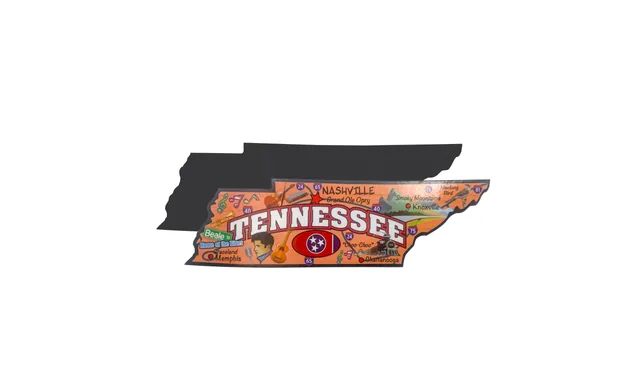
Packaging is the part of a souvenir magnet order that gets decided last and causes the most trouble. It is treated as a finishing detail, when it is actually the thing that decides whether the piece can hang on the fixture the shop already owns.
Getting it wrong is not a quality failure. It is a delivered order that the retailer cannot merchandise.
Start from the fixture, not from the piece
There are broadly three ways a magnet is presented at retail, and they are mutually exclusive in how the goods must arrive:
Hanging
On a hook or a spinner. This needs a header card or a hang hole, and it needs the piece and card to sit flat enough that a full hook does not fan out. It is the format that shows the most artwork per unit of shelf, which is why most destination racks use it.
Loose in a tray or bowl
Common where the piece is heavy or tactile and the shop wants people picking it up. Needs no card, but needs a piece whose reverse is presentable, since half the stock in the bowl is face down at any moment.
Boxed or blistered
Where the piece is priced as a keepsake rather than an impulse buy. It buys perceived value and shelf protection, and it costs both money and space.
A retailer with hook fixtures cannot merchandise loose pieces, and a retailer with counter bowls will strip the header cards off and throw them away. Ask which fixture the goods are going onto before specifying anything.
What goes on the card
The header card is doing more jobs than it looks like:
- Barcode. If the retailer scans at the till, this is not optional and it is not something to discover late. Establish whose barcode it is — yours, the retailer’s, or one assigned per destination — before artwork is finalised, because the number has to exist before it can be printed.
- Destination branding. On a shared-form range this is often the only place the location appears at full size, which makes the card part of the product rather than its wrapper.
- Required markings. Importer details, origin, warnings and language obligations are set by the destination market, and they are printed at production time. Getting them wrong is a shipment that cannot be sold as-is. This is the packaging half of the questions in the compliance list, and it is the half people forget because it feels like paperwork rather than product.
- Price or SKU space. Leave room. Retailers will apply their own label somewhere, and if you have not chosen where, they will choose for you — usually over your artwork.
The costs nobody puts in the first budget
Three of them, in rough order of how often they surprise people:
Card printing is a print run of its own. On a multi-destination range, each destination is a different card. That is a set of print origination costs sitting alongside the piece costs, and it scales with the number of destinations rather than the number of pieces.
Packing is labour. Carding, bagging and sealing happen by hand, per piece. It is small per unit and visible in total.
Packaging changes the shipping cube. A carded piece takes several times the volume of a loose one. On a full container that shows up as fewer pieces per carton and a different freight number, which is a conversation worth having before the format is locked rather than after the quotation lands.
Where to keep it simple
The pattern that survives a multi-destination range: one card design, one die, one bag size across the whole range, and only the printed content changing by destination. It is the same logic as a shared form — the tooling and the die are constant, the artwork localises.
Ranges that let each destination have its own card shape end up with a packing station that has to be reset per SKU, and that cost is real even though nobody quotes it as a line item.
What to specify with the enquiry
- Which fixture the goods are merchandised on — hook, bowl, tray or box
- Whether a scannable barcode is required, and whose it is
- Which market the goods clear customs into, since that sets the markings
- Whether the retailer applies their own price label, and where
- Carton and inner-pack preferences, if the retailer has any — many do, and they are rarely mentioned until the goods arrive wrong
Send those five with the artwork and the packaging comes back quoted as part of the piece rather than added afterwards, which is the version where there are no surprises.