Fridge Magnet Retail Packaging: Backing Cards, Bags & Barcodes
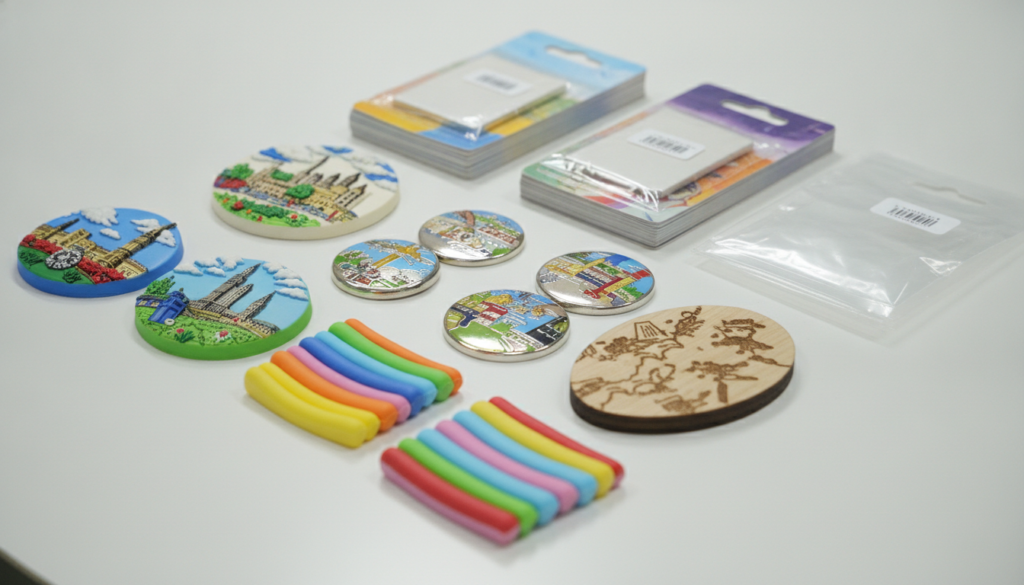
Fridge magnet retail packaging typically combines a printed backing card with a Euro-slot hang hole, an OPP polybag for protection, and a GS1-compliant barcode for POS scanning. The backing card displays your brand, product name and destination artwork, while the polybag keeps the magnet clean and prevents scratching. Barcodes are printed directly on the backing card or applied as labels, positioned where they scan cleanly at checkout without obscuring design elements.
📋 Table of Contents
Executive Summary
- Backing cards: Printed card stock with Euro-slot hang holes enables pegboard display in gift shops and museum stores, with space for brand, destination artwork and barcode.
- Polybags: Individual OPP bags protect magnets from dust, fingerprints and scratching during handling, and buyers increasingly ask for biodegradable or recycled-content alternatives.
- Barcodes: North American retailers require UPC-A (12-digit GS1 barcode), European stores use EAN-13, and Japanese retailers often request JAN codes, all of which must scan reliably at POS without manual entry.
- Material-specific needs: 3D resin magnets with fine relief detail benefit from rigid backing to prevent flexing, while soft PVC magnets can use thinner card stock because the rubber body is more forgiving.

What backing card format works best for souvenir magnets?
A printed backing card with a Euro-slot hang hole is the most common fridge magnet retail packaging format in souvenir shops. The card displays your brand, product name, destination artwork and any compliance marks, while the 6 mm diameter hang hole fits standard pegboard hooks. Card stock weight matters: lighter stock bends under the magnet’s weight, heavier stock adds cost but keeps the package flat on the hook.
Card stock weight and finish
Most souvenir magnets use 300-350 gsm coated card stock, which holds its shape on the hook and accepts full-color offset printing. Matte lamination resists fingerprints and gives a premium feel, while gloss lamination makes colors pop but shows handling marks. Museum stores often specify FSC-certified card stock to meet sustainability policies, so confirm the mill certification before printing if your buyer has requested it.
Euro-slot hang hole placement
The Euro-slot hole is punched 10-15 mm from the top edge of the card, centered horizontally. Placement too close to the edge causes tearing when customers lift the package off the hook, while placement too low shifts the magnet’s visual center below eye level on a crowded pegboard. Shops that use slatwall instead of pegboard may ask for a different hole format or a J-hook adapter, so check the buyer’s fixture type at quotation.
Design and branding area
The backing card is the buyer’s branding canvas. Space above the magnet typically carries the shop name or destination logo, while space below holds the product name, a short description and any legally required text such as choking-hazard warnings for magnets sold as decorative items. Buyers who sell through multiple locations often print generic cards and apply location-specific stickers at the shop, which reduces card inventory but adds labor.
In practice: A 3D resin magnet with multiple color layers and fine text detail needs a rigid backing card to prevent flexing during handling, because the resin body is brittle and the card acts as a structural support until the magnet reaches the customer’s fridge.
Should magnets be bagged individually or sold bare?
Individual OPP polybags are standard for fridge magnet retail packaging because they keep magnets clean, prevent scratching and stop multiple magnets from sticking together in shipping cartons. Bare magnets collect dust, pick up fingerprints and arrive at the shop looking handled, which lowers perceived value. Polybags add a small per-unit cost but eliminate the need for buyers to clean or repackage magnets before shelving.
OPP vs biodegradable film
Traditional OPP (oriented polypropylene) bags are clear, inexpensive and widely available, but they are not biodegradable. Buyers in Europe and North America increasingly request compostable PLA film or recycled-content LDPE as alternatives. PLA bags cost more and require industrial composting facilities to break down, while recycled LDPE maintains the clarity and strength of virgin film at a moderate price premium. Confirm the buyer’s sustainability requirements at quotation, because switching film types after production adds delay and cost.
Bag sealing methods
Self-seal adhesive strips are the most common closure for magnet polybags. The strip runs along the bag opening and peels to reveal a pressure-sensitive adhesive, which the packer folds over to seal the magnet and backing card inside. Heat-sealed bags offer a tamper-evident closure but require sealing equipment and are harder to open without tearing the bag, which frustrates customers who want to inspect the magnet before buying. Museum stores that emphasize presentation sometimes request resealable zip-lock bags, which cost more but allow customers to open and reseal the package.
Anti-static and anti-fog treatments
Standard OPP film can fog in humid climates or cold storage, obscuring the magnet inside. Anti-fog-treated film prevents condensation and keeps the magnet visible on the shelf. Anti-static treatment reduces dust attraction, which matters for magnets displayed in open bins or high-traffic areas where airborne particles settle quickly. Both treatments add a small cost per bag and must be specified at the time of film ordering, so buyers who sell in coastal or tropical destinations should request them upfront.
Which barcode standard do retail magnets need?
North American retailers require UPC-A barcodes, which encode 12 digits assigned by GS1. European stores use EAN-13 (13 digits), and Japanese retailers request JAN codes, which are functionally identical to EAN-13 but registered through GS1 Japan. The barcode must scan reliably at POS without manual entry, so placement, contrast and print quality all matter.
GS1 registration and number assignment
GS1 is the global standards body that assigns unique company prefixes and product numbers. Buyers who sell through multiple retailers or distributors need their own GS1 company prefix to generate barcodes for each SKU. Registration costs vary by country and the number of products the buyer plans to barcode, so buyers new to retail should budget for the initial GS1 fee and annual renewal. Suppliers cannot legally generate GS1 barcodes on behalf of the buyer unless the buyer provides their registered prefix, because each barcode must trace back to a verified company record.
Barcode placement and print quality
The barcode is typically printed on the lower third of the backing card, positioned where it scans cleanly without obscuring the destination artwork or brand logo. The barcode must have clear quiet zones (blank space) on both sides, and the bars must print with sharp edges and high contrast against the background. Low-resolution printing, colored backgrounds or reflective lamination can all cause scan failures, which force cashiers to enter the code manually and slow checkout. Test-scan the barcode on the physical sample before approving bulk production, because fixing a barcode issue after printing requires reprinting the entire card run.
SKU and inventory control
Each magnet design requires a unique barcode so the POS system can track sales and inventory by SKU. Buyers who sell magnets in multiple sizes, finishes or material types must assign separate barcodes to each variant, even if the designs are similar. Museum stores and multi-location gift shops often integrate barcodes with their inventory management software to automate reordering when stock drops below a threshold, so the barcode must match the SKU in the buyer’s system exactly.
Does packaging differ by magnet material?
Packaging requirements vary by magnet material because 3D resin, soft PVC, metal and wood each have different weight, fragility and surface-finish characteristics. Matching the packaging to the material prevents damage in transit and ensures the magnet arrives at the shop in sellable condition.
3D resin magnets
3D resin magnets are cast in multiple layers to create relief detail and color separation, which makes them heavier and more brittle than soft PVC. A rigid backing card supports the magnet’s weight and prevents flexing, which can crack the resin. Polybags for resin magnets should be slightly oversized to avoid pressure on raised details during sealing, and carton packing must include dividers or bubble wrap to prevent magnets from striking each other in transit. Buyers who order large resin magnets (over 80 mm in any dimension) sometimes request individual gift boxes instead of backing cards, because the added protection justifies the higher packaging cost.
Soft PVC magnets
Soft PVC magnets are injection-molded rubber with clean color blocks and a flexible body, which makes them lighter and more forgiving than resin. Thinner card stock is sufficient because the PVC body does not crack under normal handling. Soft PVC attracts dust and lint, so a polybag is essential to keep the surface clean. Some buyers request anti-static-treated bags to reduce dust attraction on the shelf, especially for magnets displayed in open bins where customers handle multiple pieces.
Metal magnets
Metal magnets (die-cast zinc alloy or stamped brass with enamel paint and plating) are the heaviest format, so backing cards must be thick enough to support the weight without sagging on the hook. Metal magnets can scratch each other if they shift in the carton, so individual polybags are non-negotiable. Buyers who order metal magnets with mirror-finish plating sometimes request foam inserts inside the polybag to cushion the magnet and prevent surface marring, which adds cost but protects high-value finishes.
Wooden magnets
Wooden magnets are laser-cut and engraved with UV printing, which leaves a textured surface that can snag on rough packaging. Polybags for wooden magnets should be smooth-finish OPP rather than textured or embossed film, and the backing card should have rounded corners to avoid catching the wood grain. Wood is sensitive to humidity changes, so buyers in tropical or coastal climates should specify moisture-barrier polybags to prevent warping during storage and transit.
- 3D resin: Rigid backing card, slightly oversized polybag to protect raised relief, carton dividers to prevent cracking in transit.
- Soft PVC: Thinner card stock acceptable, anti-static polybag to reduce dust attraction, lighter carton packing.
- Metal: Heavy-duty backing card to support weight, foam inserts for mirror-finish plating, individual polybags mandatory to prevent scratching.
- Wood: Smooth-finish polybag to avoid snagging, rounded-corner backing card, moisture-barrier bags for humid climates.
Key Takeaways
- Backing cards with Euro-slot hang holes enable pegboard display in souvenir shops, with 300-350 gsm coated card stock providing the right balance of rigidity and printability for most magnet formats.
- Individual OPP polybags protect magnets from dust, fingerprints and scratching, and buyers increasingly request biodegradable PLA film or recycled-content LDPE as sustainable alternatives to traditional polypropylene.
- North American retailers require UPC-A barcodes, European stores use EAN-13, and Japanese retailers request JAN codes, all registered through GS1 and printed with high contrast and clear quiet zones to ensure reliable POS scanning.
- 3D resin magnets need rigid backing and oversized polybags to protect relief detail, while soft PVC magnets can use thinner card stock and benefit from anti-static-treated bags to reduce dust attraction.
- Metal magnets are the heaviest format and require heavy-duty backing cards to prevent sagging, plus foam inserts for mirror-finish plating to avoid surface scratching in transit.
- Wooden magnets are sensitive to humidity and should be packed in smooth-finish, moisture-barrier polybags to prevent warping and snagging during handling and storage.
Can I use my own barcode numbers instead of registering with GS1?
Retailers that participate in global supply chains require GS1-registered barcodes because their POS systems verify the company prefix against the GS1 database. Using unregistered or recycled barcode numbers can cause scan failures, duplicate SKU conflicts or compliance rejections at the retailer’s receiving dock. Buyers who sell through independent gift shops or museum stores sometimes use internal SKU numbers instead of GS1 barcodes, but any buyer planning to sell through chain retailers or distributors should budget for GS1 registration upfront to avoid reprinting packaging later.
What size polybag fits a standard fridge magnet?
Polybag size depends on the magnet’s dimensions plus the backing card. A typical souvenir magnet measuring 60 mm x 80 mm on a 70 mm x 100 mm backing card fits comfortably in a 90 mm x 120 mm polybag, leaving room for the self-seal flap and avoiding tight creases that can damage raised details on 3D resin magnets. Oversized bags look sloppy and waste material, while undersized bags stress the seal and can pop open during handling. Confirm the final magnet and card dimensions at the physical sample stage, then specify polybag size to the production partner so they order the correct film width.
Do museum stores have different packaging requirements than gift shops?
Museum stores often specify FSC-certified card stock, recycled-content or compostable polybags, and minimal plastic use to align with institutional sustainability policies. They may also request custom backing card designs that incorporate the museum’s branding, exhibition themes or educational content, which adds design and printing cost but differentiates the product from generic souvenir magnets. Museum buyers typically order smaller quantities per SKU but expect higher presentation quality, so the packaging must balance sustainability, branding and cost within tighter budget constraints than high-volume tourist shops.
Ready to finalize your fridge magnet retail packaging with the right backing cards, polybags and barcodes for your market?
Request a Quote →
We produce custom souvenir magnets in 3D resin, soft PVC, metal and wood to your specification, with design proof, physical sample sign-off and pre-shipment checks before bulk. Review our full custom souvenir magnet range to compare processes, or visit our quality and compliance page to understand how sampling and inspection work at each production stage.
Written by the Magnista export team, who coordinate design proofs, sampling and production for custom souvenir magnets.